Early August brings a few certainties: the temperatures are still offensively hot, the new Starbucks seasonal menu has arrived, and parents everywhere are asking, “How is it already time for school?”
While making “welcome back to the school year” APS Gold Bars for my son’s teachers, I started thinking about school – not about supply lists or school lunches, but about what education looked like here in the Southwest before air conditioning, Wi-Fi, and spiral bound notebooks.
Growing up, I lived less than a quarter-mile from the town’s old schoolhouse (built 1917 and closed 1942), and even closer in the other direction was the new school. Of course, since the town is only about two miles long, it’s hardly impressive. During the summer, I would hear tourists ringing the old school bell, and later, when my mom became the school administrator, she would take students over for a lesson in the historic schoolhouse once a year (Living History Day, anyone?).
Today, we think of school as a pretty standardized experience: classrooms, desks, textbooks, teachers, bells, and approximately 47 forms that parents have to sign during the first week. But early education throughout the American West was a much more flexible affair.
Before formal schools became common, children learned at home, through the church, or, for families who could manage it, by attending schools farther away. Some students in the southwest territories were even sent east into the United States or south into Mexico for their education. Interestingly, those who studied in the United States later became valuable interpreters when Americans began governing New Mexico in the mid-19th century.
Of course, formal schools were not the only way children in the Southwest learned. Native American communities had their own long-established educational traditions, many of which relied heavily on oral teaching, observation, storytelling, and learning by doing. Children learned history, cultural traditions, practical skills, and their responsibilities within the community by listening to elders and watching the people around them.
Students ranging roughly from six to sixteen could all be taught in the same room, generally grouped by age or ability. One teacher could be responsible for grades one through eight, with class sizes ranging from three or four students to as many as fifty.
And these classrooms weren’t exactly equipped with modern conveniences. There was no electricity. No running water. No indoor plumbing. In the summer, open windows were the air conditioning. In the winter, a pot-bellied stove provided the heat, usually with older boys being sent outside to chop or haul the wood. Students often shared water from a communal pail, using their own cups. Paper and pencils could be expensive, so children might write on slates. Meanwhile, the teacher was expected to arrive early enough to light the fire, prepare the classroom, and perform several other jobs.
An 1872 set of rules for teachers in Colorado Territory included instructions to fill lamps, clean chimneys, bring in water and coal, and allowed male teachers one evening a week for courting. Women, however, had a slightly different arrangement: if they got married, they were dismissed.
For women in particular, heading West to teach could provide an opportunity for economic independence and even the chance to establish a homestead claim. And, as one particularly candid Montana teacher recalled, the West had another advantage: there were plenty of eligible men. Unfortunately for the teaching profession, once many of these schoolmarms married, they were no longer allowed to teach. Which meant schools experienced a rather predictable teacher shortage and a revolving door of schoolmarms.
And then there was discipline. Frontier schools tended to be considerably less concerned with hurt feelings than we are today. Students were expected to sit still, listen, memorize, recite, and generally behave themselves. There wasn’t much room for negotiating with your teacher about whether you were “in the right headspace” to do your multiplication tables that morning. The prevailing philosophy was pretty simple: you were there to learn, and the teacher was there to make sure you did.
Teaching was not exactly a lucrative career. Teachers were often poorly paid, and sometimes families couldn’t pay in cash at all. Instead, teachers might receive food, firewood, quilts, eggs, or room and board. Some teachers rotated between students’ homes, staying with a different family each week.
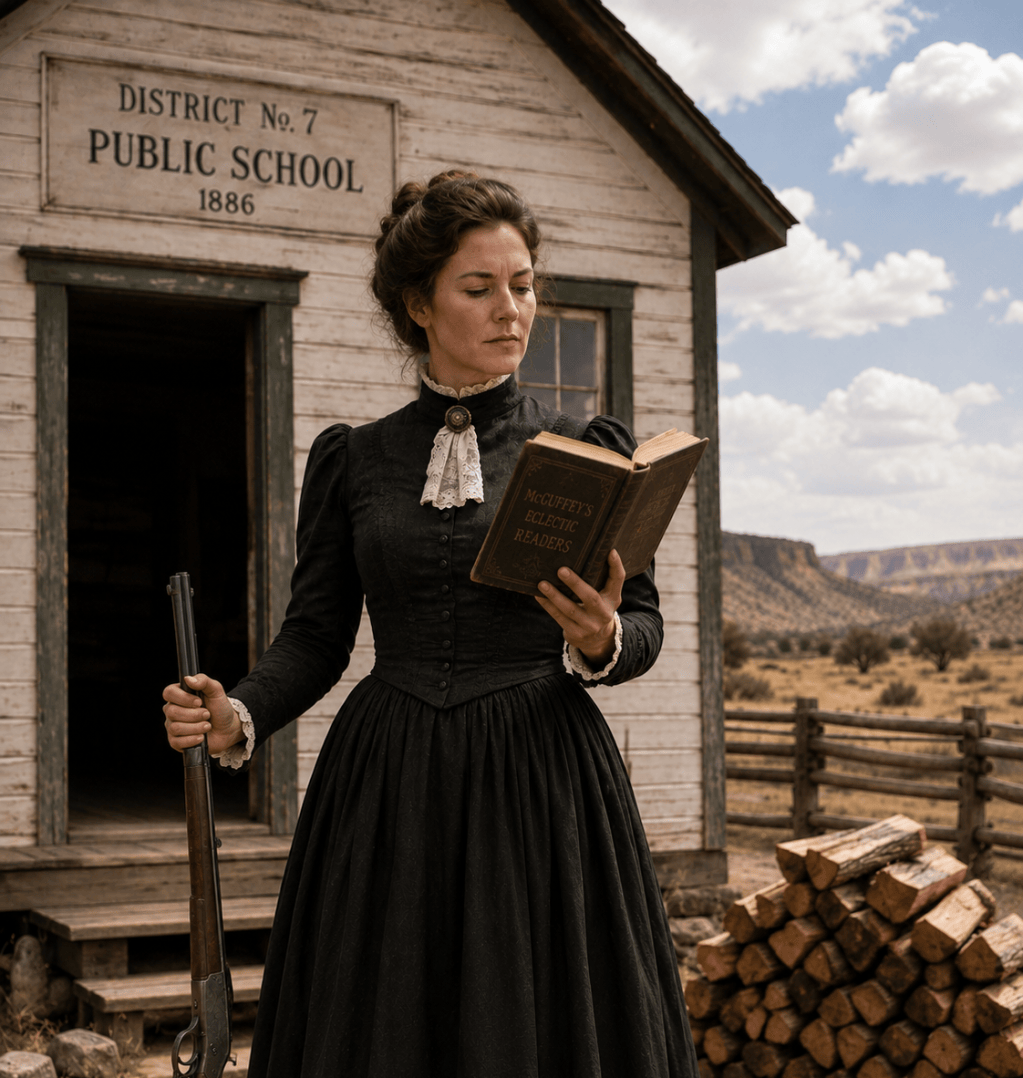
Teachers had to build relationships with their students and communities, often under incredibly difficult circumstances. One example of this in the Southwest is Sister Blandina Segale, an Italian-born Sister of Charity who came West in the 1870s to teach. She became one of those remarkable frontier figures who seemed to collect occupations as she went: teacher, advocate, nurse, social worker, and, occasionally, reluctant negotiator with outlaws (read more about Sister Blandina in a previous post!). One teacher in Nevada had so few books that she took her students to the local cemetery and taught them to read by studying the inscriptions on gravestones. In 1849, twenty-two-year-old Olive Isbel traveled from Ohio to California to open a schoolhouse. It’s said that she taught holding a loaded rifle in one hand and a book in the other because, at the time, the mission where she taught was under attack.
Despite the hardships, schoolhouses were often remarkably important places. A school wasn’t just a school. It might also serve as a church, meeting hall, polling place, theater, dance hall, or community center. Spelling bees became popular community events, and schoolhouses hosted debates, traveling lecturers, literary societies, charitable organizations, weddings, funerals, and holiday parties. Basically, if the frontier community needed somewhere to gather, the schoolhouse was probably it.
And school itself wasn’t all arithmetic and moral instruction. Children still had recess. They played tag, leapfrog, and marbles. They skipped rope and hunted crawdads in nearby creeks. Of course, frontier recess had a few potential hazards that today’s students don’t generally have to consider. Lunch came from home and might include sausage biscuits, molasses bread, fried rabbit or squirrel, and homemade cake. Honestly, the school lunch menu sounds considerably more ambitious than some modern cafeteria fare. School could be interrupted by rattlesnakes, snowstorms, outlaws, family feuds, or other assorted disasters of frontier life.
Perhaps what I find most interesting about frontier schoolhouses isn’t the lack of modern conveniences – although the fact that teachers had to haul their own coal and water is certainly admirable. It’s how much these tiny buildings represented. For many frontier communities, the schoolhouse was a symbol that people intended to stay. It was often among the first buildings to be constructed. Community members pooled their labor, timber, money, and resources to create a place where their children could learn. Even in mining camps and coal towns where children were frequently pulled out of school to work or care for family members, the schoolhouse remained a symbol of hope.
For me, that history is especially tangible. The old schoolhouse I grew up near is still there, complete with the bell that once called children to class. The bell that once marked the beginning of the school day could also serve as a town alarm. In small communities, it might be rung for a house fire, a forest fire, or a child in danger. It wasn’t just a school bell. It was the community’s alarm clock, meeting announcement, emergency siren, and now, a tourist attraction.
So as another school year begins, I’d like to take a moment to appreciate just how far we’ve come. Today, kids have air conditioning, running water, computers, libraries, and teachers who hopefully aren’t expected to split firewood before class (sorry, Mom). But the heart of school hasn’t changed much at all. It’s still a place where communities invest in their children, where older students can help younger ones, where teachers somehow manage to keep a room full of children learning, and where recess remains the most important part of the day.
The schools may have gotten bigger, the technology more sophisticated, and the lunches less likely to include fried squirrels. But give kids a little free time and a creek full of crawdads, and I’m pretty sure things would look basically the same.
Welcome back to school!
Mountain Girl


Leave a Reply