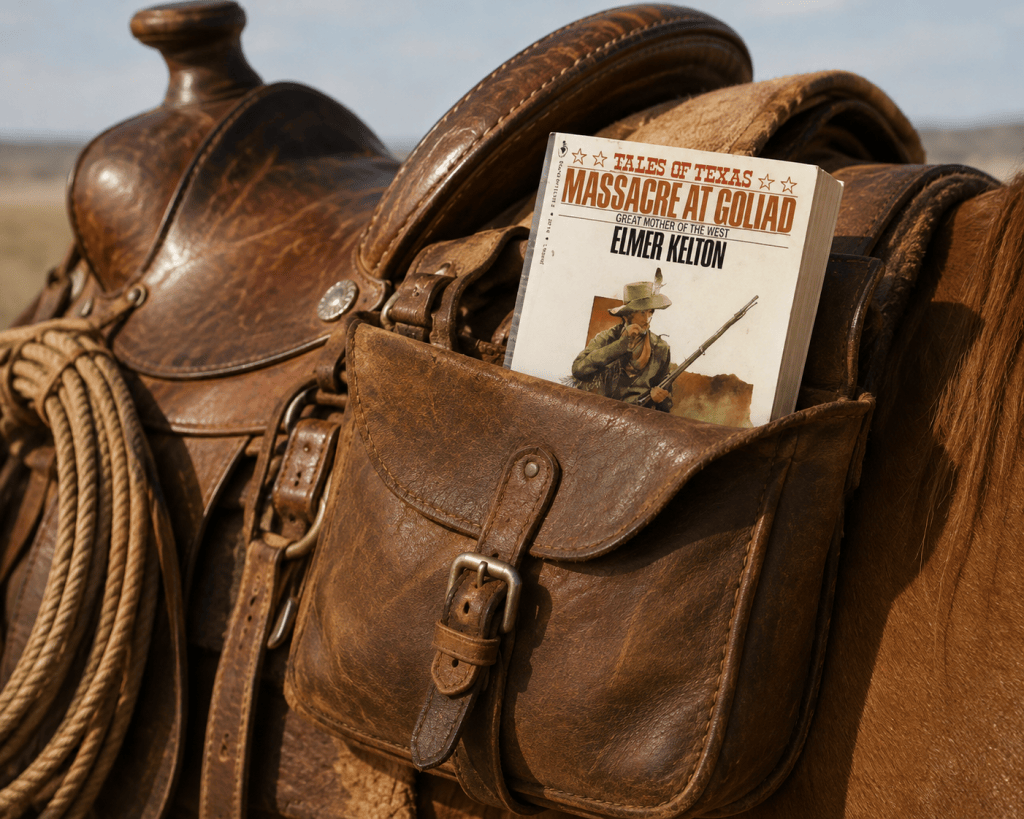
There are some books that you read, and there are some books that you can practically hear. Elmer Kelton’s Massacre at Goliad is firmly in the second category. In fact, I’m convinced that the introduction to this book can only be properly read in Sam Elliott’s voice. Deep, gravelly, slightly amused, with just enough Texas drawl to make you want to stare thoughtfully into the middle distance. As for the characters’ voices, the cowboys from that old “Cat Herders” commercial will do in a pinch.
Kelton, born April 29, 1926, in Andrews County, Texas, grew up around ranching, so it’s no wonder he knows how to help his readers conjure up cowboys. His father was a rancher and foreman, and his mother had been a schoolteacher and encouraged his writing. Kelton eventually became one of the most prolific writers of the American West, publishing more than forty Western novels. So when Kelton writes Western dialogue, he knows what he’s doing. And boy, does it show.
Massacre at Goliad, originally published in 1965, follows brothers Josh and Thomas Buckalew, two Tennesseans who, at their father’s insistence after speaking to Colonel Ames, head west in the 1830s looking for the sort of things people have historically gone west looking for: opportunity, land, and hopefully a little more breathing room than they had back home. Instead, they find Texas. Which, as it turns out, is complicated.
The novel opens with a narrator of sorts (see above: is that Sam Elliott speaking?), setting up the story we’re about to hear from Josh Buckalew’s perspective. From there, Kelton drops us into the world of 1830s Texas, where relationships between recent Anglo-American arrivals, established Tejanos, Mexican authorities, and increasingly restless settlers are anything but simple.
And then there’s the dialogue. Early in the book, Thomas catches Josh after a fight:
“Thomas caught my sleeve and said roughly, ‘The mail has done left. You lost the fight; now let it go.’
‘You didn’t even ask me how come I was fightin’ them.’
‘I don’t reckon as how I care. A man ought to have more pride than to git hisself stomped with half the settlement watchin’, and laughin’ at him.’”
Honestly, I love this. Kelton doesn’t just tell you that these people are from Tennessee. He makes them sound like they’re from Tennessee. The cadence, contractions, vocabulary, and rhythms of speech make the characters feel like actual people rather than historical mannequins. I was probably three chapters in before I had half a mind to start talkin’ like ‘em, afly like, and call myself Cattle Kate.
The historical setting is where the book gets particularly interesting. Most people have at least a passing familiarity with the Alamo: even people who couldn’t tell you who Santa Anna was can probably summon an image of the famous mission and the “Remember the Alamo!” battle cry.
Goliad tends to get less attention. And that is a shame, because the story of Goliad is every bit as dramatic… and arguably more horrifying.
One small historical clarification is worth making here: what we commonly call the “Goliad Massacre” followed the Battle of Coleto, rather than being a battle at Goliad itself. In March 1836, Colonel James W. Fannin’s Texian force attempted to retreat from Goliad toward Victoria. Mexican General José de Urrea caught them and the Texans ultimately surrendered. Typically, surrender meant captivity, not death. Imagine the shock of Fannin’s men when Santa Anna ordered their execution. On Palm Sunday the prisoners were divided into groups and marched out of Goliad under guard. Mexican soldiers then opened fire on them. In all, 342 men were executed, while a small number escaped or were spared.
And this is where Kelton’s approach works so well. He doesn’t turn the story into a history textbook. Instead, he allows readers to experience the Texas Revolution through people who don’t know how history is going to turn out. Josh and Thomas aren’t sitting around saying, “Well, according to the Texas Revolution timeline, Santa Anna should be doing X right about now.” They’re just trying to survive.
The book spends relatively little time at the Alamo, instead focusing on events that are often pushed to the margins of the Revolution. Kelton also gives considerable attention to the complicated relationships between Tejanos and the newly arrived Anglo settlers – it reminds us that the Texas Revolution wasn’t simply “Texans versus Mexicans.” The population of Mexican Texas was far more diverse, and the loyalties and motivations of individuals were considerably messier. History is almost always messier. And, frankly, that’s what makes it interesting.
The Buckalew brothers give Kelton a particularly useful way to explore that mess. They are outsiders trying to make sense of a place that is changing rapidly around them. They have their own disagreements, ambitions, prejudices, loyalties, and ideas. As the political situation deteriorates, the brothers – and the people around them – are gradually pulled into something much larger than themselves. That human element is what makes Massacre at Goliad more than just a historical Western.
It’s also remarkably short, so it’s not one of those books where you need to clear your schedule, notify your loved ones, and pack provisions before beginning. Kelton moves the story along briskly, and there is very little unnecessary wandering. My one real complaint is that the ending feels rushed. After spending so much time developing the characters and carefully building the political and personal tensions, the conclusion seems to sprint toward the finish line. But I suppose that’s what sequels are for.
What I especially appreciate about Massacre at Goliad is that it makes a complicated period of history approachable without making it feel dumbed down. Kelton uses some familiar Western tropes, and there are moments when the book feels very much like a product of its 1965 publication date, but that’s part of the charm. And, perhaps most importantly, it makes the audience want to learn more.
I can definitely recommend Massacre at Goliad to people who might look at a nonfiction book about the Texas Revolution and decide they suddenly have an interest in literally anything else. This fictional take is manageable, engaging, and gives readers a glimpse into the political, cultural, and social complexity of Texas in the 1830s. Plus, there are cowboys.
So if you’re looking for a quick historical fiction read, or if you’re trying to sneak a little history lesson in without feeling like you’re actually reading history, give Elmer Kelton a try.
Time to skedaddle,
Mountain Girl
 Mountain Girl Goes
Leave a comment