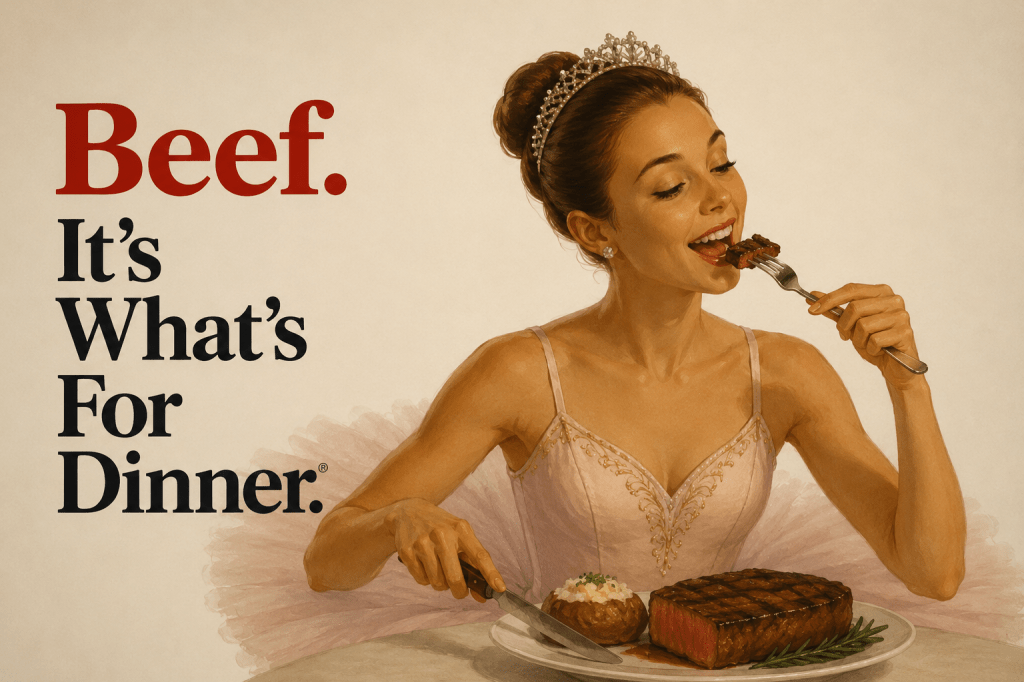
To start today’s post, I have a question: Do you have a song that evokes the American West? If you think you don’t, let me tell you: you absolutely do! Or at least, you do now. No, it’s not “Now We Ride, Really,” from the movie “Rango”..… although that is a good one. And it’s not the theme from “The Good, The Bad, and The Ugly” (but Ennio Morricone may have been inspired by our man of the week) either. Okay, so there are a lot of iconic cowboy Western compositions. This piece is behind cattle drives in commercials, square dances in cartoons, and practically every parody of a cowboy ever made, and somewhere between “Beef. It’s What’s for Dinner,” and every Western you’ve ever half-watched, Aaron Copland’s music became the music of the frontier.
Here’s the thing, “Hoedown” wasn’t originally written to stand on its own. It was written for a ballet. Yes, a ballet – tutus, pointe shoes, the works. Stay with me. The piece comes from Aaron Copland’s 1942 ballet Rodeo, and it falls into a category of music with a wonderfully German name: Gebrauchsmusik, which literally means “utility music.” Unlike symphonies, which exist for the sole purpose of being listened to and appreciated, utility music is meant to enhance something else, whether that be a ceremony, a film, a play, or, in our case, a ballet. Copland’s score doesn’t just accompany Rodeo; it gives the story life.
In this ballet, forget Tchaikovsky’s ballroom waltzes, swans, and dancing toymakers. Instead, this story is full of rope tricks, bronco riding, and maybe a little two-stepping. Considered one of the first American ballets, Rodeo seems to have successfully combined the athletic discipline of classical dance with the energy of a Broadway musical (anyone else immediately think of Cats!? No?). The star of the show is called “The Cowgirl,” and she is wonderfully awkward. Like a manic pixie dream girl in cowboy boots. Rather than the usual boy-meets-girl romance of classical ballet, Rodeo tells the story of a tomboy cowgirl desperately trying to fit in with the ranch hands while winning the attention of the Champion Roper. Unfortunately for her, she’s competing against an entire crowd of polished young women who seem to understand this whole “being feminine” thing much better than she does. The poor Cowgirl spends much of the ballet trying – and spectacularly failing – to be accepted. She rides, she ropes, she imitates the cowboys, she embarrasses herself… Repeatedly. The choreographer for the ballet, Agnes de Mille, explained: “She acts like a boy, not to be a boy, but to be liked by the boys.” That one sentence says so much. Throughout the ballet she bounces between confidence, vulnerability, determination, and insecurity, all while dancing some incredibly demanding choreography that mimics bronco busting and ranch work. By the end, she finally attends the ranch dance in a dress instead of cowboy clothes and, after all her misadventures, finally captures the Champion Roper’s attention.
Of course, Rodeo isn’t really remembered for its story. It’s remembered because of “Hoedown.” It’s energetic, joyful, and impossible to sit still through. This, of course, is unsurprising because the piece is actually taken from an Appalachian classic fiddle tune “Bonaparte’s Retreat,” recorded by William Hamilton Stepp. The Scots-Irish folk tune traces its roots back to around 1815, celebrating Napoleon Bonaparte’s retreat from Russia.
Over the decades, “Hoedown” has developed a second life entirely separate from Rodeo. Progressive rock band Emerson, Lake & Palmer recorded a blistering version in 1972. Béla Fleck and the Flecktones later gave it a jazz fusion makeover. James Horner borrowed its unmistakable energy in “An American Tail: Fievel Goes West” and echoed it again during the lively Irish dance scene below decks in “Titanic.” Then, of course, came the advertising campaign that permanently embedded it into American culture: “Beef. It’s what’s for dinner.” If you heard those words in Robert Mitchum’s (later, Sam Elliott’s) voice, you’re not alone.
Copland’s influence also reached some of Hollywood’s greatest film composers. Listen closely to John Williams’ overture for “The Cowboys” or Elmer Bernstein’s score for “The Magnificent Seven,” and you’ll hear echoes of Copland’s broad harmonies and sweeping musical landscapes. He essentially taught audiences what the American frontier should sound like.
What’s especially fascinating is that this wasn’t accidental. Some of Copland’s earlier work reflected photographer Alfred Stieglitz’s belief that American artists should create art rooted in the ideals of American democracy rather than simply imitating Europe. Other iconic Southwestern artists – Ansel Adams and Georgia O’Keeffe among them – embraced similar ideas. They weren’t trying to recreate European traditions. They wanted to capture something unmistakably American. Copland did exactly that.
He managed to compose music that somehow sounds like wide-open skies, endless prairie, dusty boots, and optimism all at the same time. That’s quite an accomplishment for someone writing notes on a page.
And if this post has you mentally playing “Hoedown” for the rest of the day….. well, I can’t really say I’m sorry. It’s been stuck in America’s head for over 80 years. Welcome to the club.
Yeehaw,
Mountain Girl


Leave a Reply