It’s still raining here in Albuquerque, so you know what that means: It’s time to make some popcorn, grab a blanket, cozy up on the couch, and find a movie! The movie in question? Three Amigos! Because if there’s one thing that pairs beautifully with a rainy afternoon, it’s three incompetent Hollywood actors, a Mexican village in desperate need of help, and a whole lot of questionable singing.
Released in 1986, Three Amigos! is the movie that helped solidify the iconic comedic partnership of Steve Martin and Martin Short. From Father of the Bride and The Prince of Egypt to Only Murders in the Building and their various comedy specials, these two have been making us laugh for decades. Thank goodness for that, because John Candy was originally offered the role of Ned Nederlander! But anyway, that’s beside the point of this post (Sorry, Chevy Chase).
Three Amigos! happens to be a childhood favorite of mine and my brother’s. My childhood nickname from my dad was even Ned, if that tells you anything. I know, an interesting choice for kids, but when your uncle can quote the entire movie from memory, it tends to make an impression. Besides, it was that or Caddyshack, and frankly, I think we turned out okay.
Three Amigos!, written by Steve Martin, Lorne Michaels (the creator of Saturday Night Live), and Randy Newman (the Disney/Pixar composer, not to be confused with his cousin Thomas Newman, the other Disney/Pixar composer) the film follows three down on their luck silent-film actors who find themselves unemployed when their studio fires them.
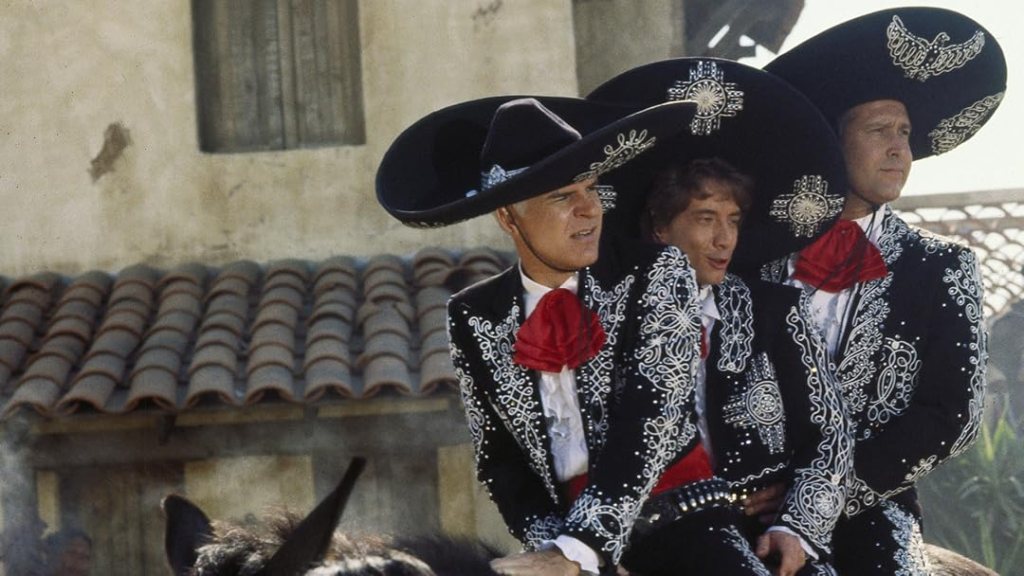
Lucky Day (Steve Martin), Dusty Bottoms (Chevy Chase), and Ned Nederlander (Martin Short) have spent their careers playing the heroic Three Amigos, saving damsels and defeating villains on the silver screen. Unfortunately, their acting careers were about as stable as a tumbleweed in a tornado.
Enter Carmen, a desperate young woman from a small Mexican village terrorized by the notorious bandit El Guapo and his gang. Having seen the Amigos on screen, Carmen mistakenly believes they are actual heroes and hires them to save her village. The three accept, naturally assuming that they have been booked for a public appearance. They’d sing a little, sign a few autographs, the usual Hollywood star stuff. Imagine their surprise when they realize that El Guapo’s bullets are real, his gang is armed, and no one bothered to tell them this wasn’t a movie set.
It’s a classic case of mistaken identity, with a dose of Hollywood ego, Western cliches, and three men who probably shouldn’t be trusted to operate a toaster, let alone save a village.
The chemistry between Martin, Chase, and Short is what makes this movie work so well. Martin and Short are almost childlike in their character’s enthusiasm, while Chase provides the deadpan confidence of a man who has absolutely no clue about what’s going on but is determined to pretend otherwise. The movie pokes fun at nearly every Western trope imaginable, from dramatic showdowns to heroic speeches and, of course, there has to be a cantina scene.
Of course, no discussion of Three Amigos! is complete without referencing the “plethora” scene. El Guapo’s men are planning his birthday party, and he asks Jefe if he has a plethora of piñatas. Jefe assures him they do, despite having no idea what the word means. El Guapo, understandably confused, asks why Jefe would claim to have a plethora when he doesn’t even know what a plethora is. It’s a simple joke, but the delivery is absolutely perfect. The scene has become so iconic that I suspect half the people who use the word “plethora” learned it from this movie. The other half are probably just trying to impress someone at a dinner party.
And speaking of birthdays, Randy Newman actually wrote one of Steve Martin’s favorite scenes: El Guapo’s 40th birthday celebration. After opening a gift, the feared bandit gleefully exclaims, “It’s a sweater!” Nothing says outlaw quite like the excitement of receiving knitwear made by one of your men.
Now, I wouldn’t be me if I didn’t mention that Three Amigos! has some New Mexico connections. Some of the filming took place in Grants, a town a little over an hour west from Albuquerque. So, if you’ve ever driven through the area and thought, “This looks like a place where three incompetent actors might accidentally save a village,” well, you’re not entirely wrong.
And then there’s the music. The cantina scene featuring “My Little Buttercup” is one of the greatest comedic musical sequences of all time. Three men in ridiculous costumes (clearly a parody of the charro attire – read more here), Lucky Day introducing them as “not Mexican,” and serenading a room full of patrons that are not impressed somehow manages to create a scene that is both utterly absurd and genuinely endearing in its cringiness. If you haven’t seen it, please do yourself a favor. If you have, then enjoy the song stuck in your head for the next three to five business days.
The movie’s musical score was composed by Elmer Bernstein, not Randy Newman, although Newman did write the songs sung in the movie including “My Little Buttercup,” “Blue Shadows (On the Trail)” (How did I miss this as a lullaby for my son? Lost opportunity. Learn from my mistakes), and “The Ballad of the Three Amigos.” Bernstein was no stranger to Westerns, having composed the scores for The Magnificent Seven and True Grit (his musical styling for these probably influenced by Aaron Copland). He also had a knack for comedy, having worked on Airplane!. It’s a fitting combination. The sweeping, dramatic music gives the film the grand, heroic atmosphere of a classic Western, even when the heroes are doing something spectacularly stupid.
It is worth remembering that the film is very much a product of its time. Its portrayal of Mexican characters and culture includes stereotypes that can be uncomfortable for modern audiences. The movie’s humor relies heavily on exaggerated accents, costumes, and caricatures. Those elements deserve to be acknowledged, particularly when watching the film today. At the same time, the story’s central joke is aimed squarely at Hollywood’s manufactured heroes and the absurdity of confusing movie magic with real-world courage. The villagers aren’t helpless because they’re incapable; they’re desperate because a violent gang is terrorizing them. And the Amigos, for all their foolishness, eventually discover that being a hero means something rather different when the bullets aren’t blanks.
For all its silliness, Three Amigos! has a surprising amount of heart. Beneath the musical numbers, ridiculous costumes, and jokes about invisible horses is a story about three washed-up actors discovering that they might actually be capable of something worthwhile. They start out believing they’re the heroes because they’ve played heroes on a screen. By the end, they learn that courage isn’t about having a catchy theme song or a dramatic entrance (although those are contributing factors). It’s about showing up when someone needs you, even if you have absolutely no idea what you’re doing. And isn’t that what we’re all trying to figure out, anyway?
So, the next time you’re looking for something to watch, give Three Amigos! a try. Make some popcorn, grab a blanket, and prepare to laugh at three men who make the average tumbleweed look like a tactical genius.
Just remember: If someone asks whether you have a plethora of piñatas, make sure you know what a plethora is before you answer. Would I say I have a plethora of movie recommendations? Yes. Yes, I would.
Wherever liberty is threatened, you will find,
Mountain Girl


Leave a comment