Thanksgiving is probably my favorite holiday for many different reasons: the food, family gatherings, the food, reflecting on gratitude, the food, thinking about the history of the holiday, and, of course, the food. This year, as in most years, Thanksgiving falls in the same week as my mom’s birthday. So, in honor of both, I thought I’d dive into a little family history. Don’t worry, it’s actually really cool. This is the story of my five times great-grandmother, Lydia Jane (Little) Pursley.
Now, if you’ve ever looked into your family tree, you know that sometimes you find little more than a name, a date, and maybe even a location of birth and death. I’ll be the first to admit I can get sucked into a family tree rabbit hole (an inherited trait from my father, from his mother, from her father, from his mother, and so on. You get the idea.)..… this time I made it all the way to mid 1600s Scotland. But, I got back on track! Every once in a while, you stumble across a person that makes you wish you could sit down with them for a cup of coffee. Lydia Little Pursley is definitely one of those people. She was a frontier woman, a mother of nine, and someone who wasn’t particularly interested in waiting around for the men to get things done.
In one account of the early history of Tonti Township in Illinois, Lydia is described as a medium-sized woman with “dauntless bravery.” Another account describes her as having been born and raised on the frontier, with “wonderful nerve” and the ability to handle a rifle as skillfully as any ranger. As it turns out, she had a pretty good opportunity to demonstrate those skills.
On September 9, 1814, a confrontation took place near Hill’s Fort, outside present day Greenville, Illinois. A group of approximately thirteen Illinois Rangers and civilians found themselves facing a much larger party of Native Americans, reportedly numbering around eighty. Needless to say, the odds weren’t exactly in their favor.
Among the men involved was Thomas Higgins, a frontiersman and ranger who would become known for his bravery during the encounter. When the fighting began, Higgins managed to kill one of his attackers before attempting to retreat toward the fort. However, his wounded comrade, William Burgess, was lying on the ground and needed help. Higgins wasn’t about to leave him behind. He attempted to lift Burgess onto his horse, but the frightened animal pulled away and bolted. Higgins told Burgess to crawl toward the fort while he stayed behind to draw the attackers away from him.
Unfortunately, Higgins soon found himself surrounded. He was wounded in the leg, shot again as he approached the fort, and struck by a tomahawk that reportedly severed one of his ears. By the time the fighting was nearly over, Higgins was badly wounded and almost completely exhausted.
Enter Lydia.
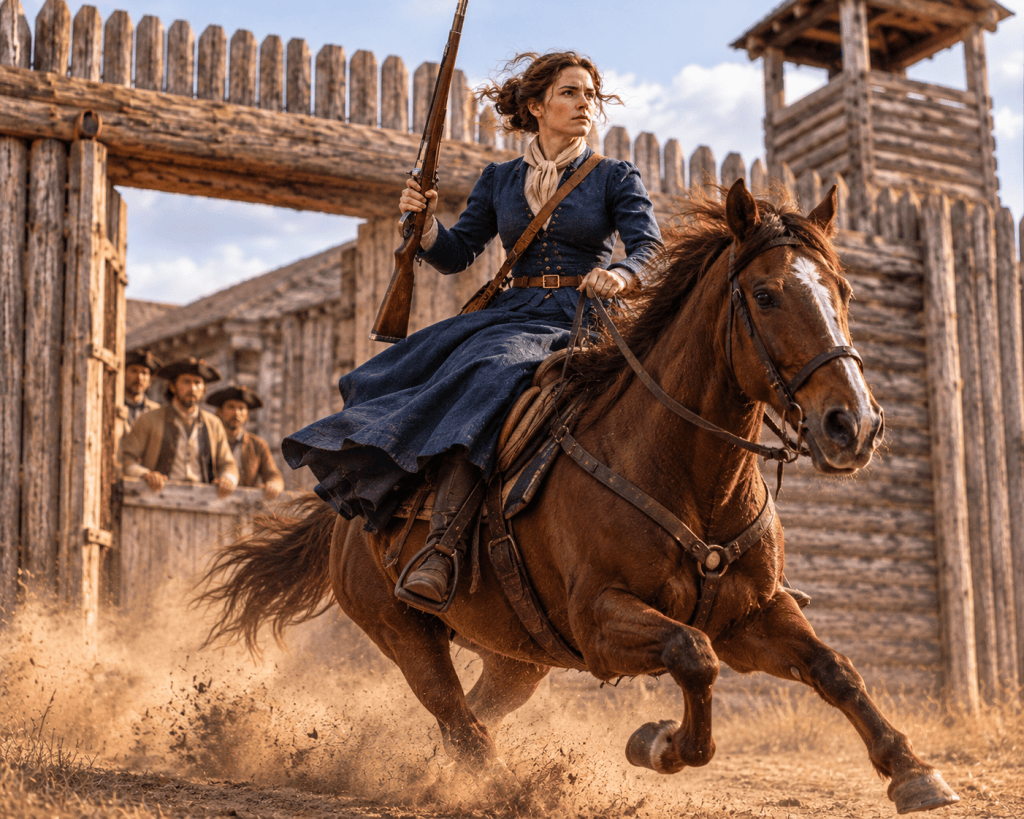
The fighting had been visible from the fort, but the men inside weren’t particularly eager to venture out and rescue Higgins. Apparently, watching someone fight for his life from a safe distance was one thing; actually doing something about it was another. According to Governor John Reynolds’ account in his pioneer history of Illinois, Mrs. Pursley became so upset watching Higgins being attacked that she declared she couldn’t stand to see such a brave man murdered. She mounted her husband’s horse and rode out to his rescue (where her husband was, I have no idea). The men inside the fort, apparently unable to let a woman go alone, followed her.
John Frost tells a similar story in Pioneer Mothers of the West. According to Frost, Mrs. Pursley repeatedly urged the men to help their comrade, but they were too frightened to move. Finally, she found a rifle, mounted a horse, and declared that “so fine a fellow as Tom Higgins should not be lost for want of help.” He goes on to explain that the men were effectively shamed into action. Apparently, being outdone by a woman was a greater indignity than facing a rather large group of armed attackers.
A 1923 article in California’s Mill Valley Record, published in its “Stories of Great Scouts” section, also recounts the incident. In that version, Mrs. Pursley cries out, “I will not see such a brave man die!” before springing onto a horse and riding to Higgins’ aid.
Regardless of which version you prefer, the ending is much the same. Lydia’s actions inspired several men to follow her, and the group reached Higgins just as more attackers were preparing to descend upon him. They managed to get the nearly unconscious ranger onto a horse and carry him back to the fort. Higgins survived, although his injuries reportedly troubled him for years. Later in life, he received a pension for his service and became a doorkeeper for the state assembly in Vandalia, Illinois. Not a bad outcome for a man who nearly lost his life, and certainly a memorable one for the woman who helped save it.
Lydia’s story is only one part of the family’s history. Her husband, William Darrel Pursley, is credited as one of the first settlers in what became Tonti Township, arriving in the area in 1822. He also served as one of Illinois’ early Justices of the Peace.
William died shortly afterward, leaving Lydia and their children. His estate was inventoried in March 1828 and amounted to $301.75 (a bit over $10,500 today). Thankfully, the records include an itemized list of the family’s possessions, which I find almost as interesting as the rescue story itself. Among the items were hogs valued at $1.25 apiece, a plow for $4, an ax for $1.50, a spinning wheel for $1, and a loom valued at $11. There was also a yoke of steers worth $18, a cow for $5.75, a heifer for $2.50, and a cart valued at $5.37½. Household goods included quilts, a counterpane, three chairs at fifty cents each, and even smoothing irons. It’s a small snapshot of what life looked like for a frontier family. I imagine the spinning wheel got quite a workout with so many children in the household.
An interesting tidbit: William Pursley was known for raising fine horses, and the family enjoyed horse racing and gambling. Lydia, along with a few of the children, including her youngest son Guion Black Pursley, eventually moved to Texas in the mid 1840s, where he continued raising fine horses and reportedly traveled back to Illinois to buy and sell them.
Anyway, I think there’s something pretty special about finding a story like hers tucked away in the pages of old histories and newspapers. This Thanksgiving, I’m grateful for family, good food, and the opportunity to learn a little more about the people who came before me. Lydia’s story is a reminder that our ancestors were more than just names on a family tree. They had personalities, adventures, and, occasionally, a willingness to ride headfirst into a fight when everyone else was too chicken to help.
I don’t know about you, but I think that’s something worth being thankful for… and something to try to live up to!
Mountain Girl


Leave a Reply