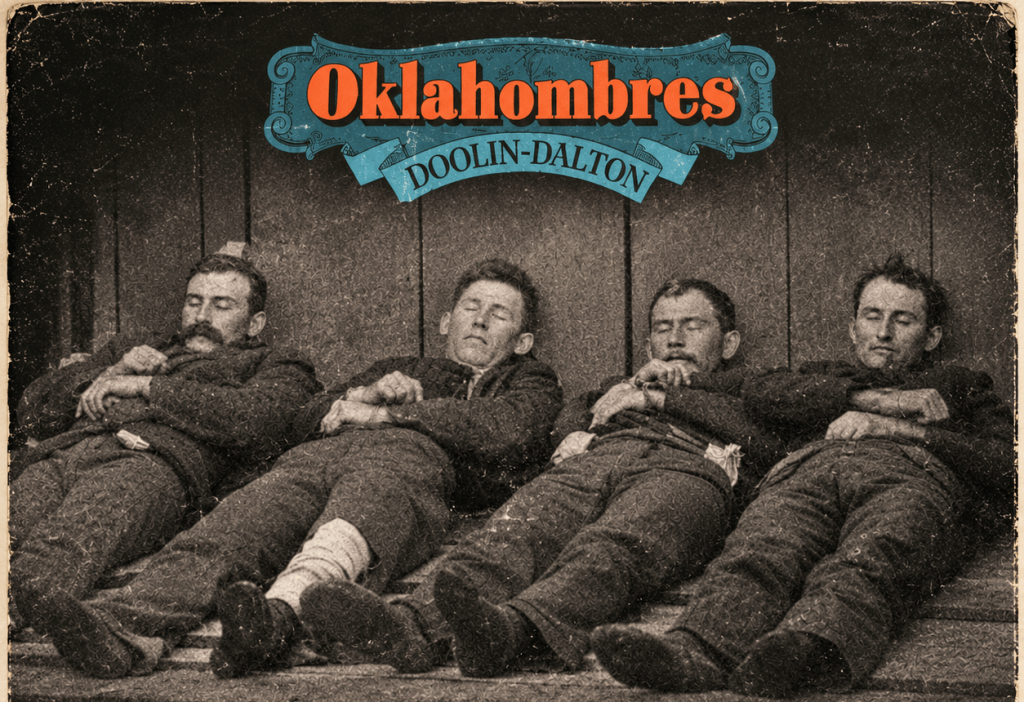
It’s been awhile since we’ve talked about outlaws, and I figure we’re probably due. This week, let me introduce you to the Oklahombres. Did the gang name make my decision on a blog topic this week? Absolutely. I mean, Oklahombres. That’s just good history right there. The gang, better known as the Doolin-Dalton Gang, also called the Wild Bunch (a name later adopted by Butch Cassidy’s gang), was formed by the remnants of the Dalton, or Dalton Brothers, Gang. These guys specialized in robbing banks, stagecoaches, and trains across the Oklahoma Territory and Kansas, leaving a trail of stolen money, shootouts, and unhappy lawmen behind them. Interestingly, Bill Doolin, one of the leaders of the group, had a Robin Hood reputation, preferring to target wealthy institutions, spend money freely in the towns the gang hid out in, and had enough local support that he was able to successfully evade the law….. for a while. This just proves that if you’re charismatic enough, people like you, even if you’re a wanted criminal. Not that I would recommend robbing trains for a living, maybe just go into door-to-door sales. But I suppose the job market was a bit different in the 1890s.
Anyway, Bill Doolin didn’t start out as a notorious outlaw. He worked as a cowboy in Kansas and the Cherokee Outlet, and he and Bill Dalton (eventual co-leader of the gang) even worked together at the same ranch in Oklahoma Territories. Eventually, I guess ranch work lost its appeal, because the two decided they’d prefer the thrill of bank robberies. I mean, naturally, if you’re tired of your job, a little federal manhunt definitely adds a little excitement to your life.
The original Dalton Gang had already made a name for itself, but luck ran out in October 1892 in Coffeyville, Kansas. During an attempted double bank robbery, several members were killed, including three of the Dalton brothers. You’d think that that would have served as a lesson to Bill Dalton, discouraging him to follow in his brothers’ footsteps. After his brothers’ deaths, he joined forces with Bill Doolin and other surviving outlaws from the Dalton Gang to form the Wild Bunch. The gang included George “Bitter Creek” Newcomb, Charlie Pierce, “Arkansas Tom” Jones, “Dynamite Dick” Clifton, and William “Tulsa Jack” Blake, among others. The gang even had their very own groupies, Little Britches and Cattle Annie, who had first idolized the Doolin-Dalton Gang by reading dime novels. With a fresh crew and a reputation to uphold, they continued robbing banks and trains throughout the region.
One particularly memorable incident appeared in the Meade County Globe on June 15, 1893:
“Four masked robbers held up the California express on the Santa Fe road half mile west of Cimarron last Friday….. When they arrived the messenger refused to open the door and after firing some shots into the car they blew the door off with dynamite….. The robbers took the contents of the way safe and commanded Whittlesey to open the thorough safe but he could not do so. It is thought they secured about $1000 in silver, and mounting their horses rode off to the south.”
I don’t know about you, but if I heard that my train was delayed because four masked men just blew up the express car, I think I’d change my travel arrangements.
One of the gang’s favorite hideouts was Ingalls, Oklahoma, a small community where the outlaws were welcomed for their free-spending ways. As long as they behaved themselves around town, residents were apparently willing to look the other way. It was a mutually beneficial arrangement..… until the federal marshals showed up. By the summer of 1893, several gang members were staying in Ingalls, spending their days at the Ransom Saloon and lodging at the local hotel….. chillin’ with their Oklahomies, so to speak. Unfortunately for them, U.S. Marshal Evett Dumas “E.D.” Nix learned of their whereabouts and assembled a posse of approximately 27 deputy marshals to bring them in. The posse camped near a creek outside town the night before the raid. A local boy spotted them the next morning and raced back to Ingalls to tell the Oklahombres, “The marshals are coming!” As luck would have it, the warning gave the outlaws enough time to saddle their horses and make an escape. Did they flee town immediately? Of course not. That would have been sensible. Instead, they returned to their poker game at the saloon. As Kenny Rogers famously sang, “You’ve got to know when to hold ’em, know when to fold ’em, know when to walk away, and know when to run.” Personally, I would’ve gone with the “run” option, but hey, maybe it was a really good hand.
On September 1, 1893, the marshals descended on Ingalls, and the resulting gunfight became one of the bloodiest confrontations between outlaws and lawmen in the region. The Battle of Ingalls is often compared to the famous Gunfight at the O.K. Corral in Tombstone, Arizona. Yet, despite its deadly intensity, Ingalls remains far less well known. Perhaps it lacks the Hollywood notoriety, or perhaps the name doesn’t quite have the same ring to it. In any case, the battle marked a turning point for the gang. Gunfire erupted around the saloon and throughout town, leaving several people dead or wounded, including lawmen, outlaws, and bystanders. Deputy Marshal Thomas Hueston was killed, and Arkansas Tom Jones was captured. Other gang members, including Bitter Creek Newcomb, managed to escape despite being wounded.
Although the outlaws escaped the immediate consequences of the Ingalls gunfight, their luck eventually ran out. The robberies continued, but so did the pursuit by law enforcement. In January 1896, Deputy U.S. Marshal Bill Tilghman captured Bill Doolin in a bathhouse in Eureka Springs, Arkansas. Doolin was returned to the Guthrie, Oklahoma, jail, but he later escaped with several other prisoners. Apparently, even jail couldn’t convince this man to reconsider his career choices. His freedom was short-lived. On August 25, 1896, a posse led by Heck Thomas tracked Doolin near Lawson, Oklahoma Territory. When Thomas called on him to surrender, Doolin drew his revolver and fired. Deputy Bill Dunn responded with a shotgun, while Thomas fired his rifle, killing Doolin in the exchange. The man who had helped terrorize the region for years was dead, and the Oklahombre’s days were numbered. Over the following years, the remaining gang members were captured or killed, with the last of the group gone by the end of the 1890s.
Their story also found a second life in popular culture, having been made into a Western film in 1949 (“The Doolins of Oklahoma”). Just a couple decades later, the Eagles featured “Doolin-Dalton” as the opening track of their 1973 album Desperado, drawing inspiration from the gang’s history and the romanticized mythology of the American outlaw. And so, the Oklahombres rode into history: a gang of former cowboys who traded honest work for bank robberies, made themselves local celebrities, and apparently considered a poker game more important than an approaching posse. They may have been the last great bandits of the Old West, but they certainly weren’t the last criminals to discover that charisma can only get you so far. Eventually, the law catches up with you. Especially if you keep stopping to play cards with a bad bet.


Leave a Reply