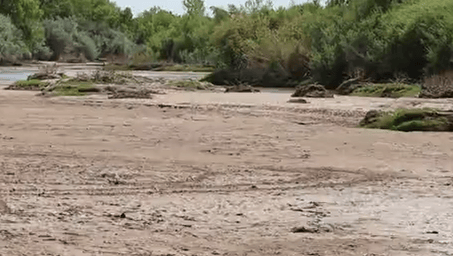
Here’s the deal: as of this month, an unprecedented 87 miles of the Middle Rio Grande have gone dry. Eighty-seven miles. As much as I wish it was, that is not a typo, nor is it something I expected to hear about the river that has been the lifeblood of the Southwest for centuries.
So, I’d like to talk about water. Specifically, I’d like to talk about the history of water scarcity in the Southwest, particularly along the Rio Grande, and why a problem that feels increasingly urgent today is actually a very old one. This post will be the first in a three-part series over the next couple months about water in the Southwest, because – much like trying to navigate Daedalus’ maze in Greek mythology – the subject gets very complicated very quickly. Imagine each monster you encounter gives you a different map and swears it’s the right one.
Let’s begin with a science lesson: When it rains or snows, some of that water runs into rivers and streams. Some soaks into the soil and eventually makes its way through sediment and rock until it encounters a layer it can’t pass through. Once there, water can sit for thousands, if not tens of thousands, of years (as my son might say, “a hundred a million a years”). Here’s why that’s important: ground water and surface water aren’t mutually exclusive. If you pull up too much groundwater from an aquifer connected to a river, the river can lose some of its flow, or vice versa. Divert too much water from a river and the groundwater cannot be properly replenished. And that 87 miles mentioned earlier? One hundred percent of Albuquerque’s drinking and irrigation water is now being supplied solely from groundwater.
Humans have understood the importance of groundwater for a very long time. From villages of the ancient Middle East to the American Southwest developed around wells, springs, and waterways. People hauled up water with buckets, pulleys, and grit, and eventually, with the aid of windmills and pumps. Wells made it possible to farm on land that had no business cultivating wheat and cotton before. Heck, even the construction of Las Vegas’ casinos was dependent on wells (read more about the importance of water and Las Vegas’ beginnings on this previous post).
Water has always been the limiting factor in the Southwest. New Mexico happens to be a particularly good example. The state is enormous – about 121,000 square miles – but has very little naturally occurring surface water….. only 155 square miles. The average precipitation is sparse, at best, and what rain we do receive often comes during the summer monsoon season. Yet, somehow, people have managed to farm here for centuries. That is, of course, in part thanks to the acequia. Long before modern irrigation districts and concrete canals, the Native Americans of the region had their own system of moving water across the landscape. Spanish settlers soon adapted and expanded these systems into the acequia traditions they were already familiar with, which remain an important part of New Mexico’s agricultural heritage today (interested in more about the history of acequias?).
The river has never been just a river. It has been a source of food, transportation, settlement, economic opportunity, and survival. For centuries, different peoples have depended on it: Native American agriculturalists, Mexican communities, Anglo settlers, modern cities, farmers, industries, ecosystems..… the list goes on.
Spanish colonization began on the banks of the Rio Grande when Don Juan de Oñate’s expedition arrived there in 1598 (an early version of Thanksgiving occurred here). Centuries later, following the Mexican-American War and the Treaty of Guadalupe Hidalgo in 1848, the political landscape changed again. Railroads arrived in the late nineteenth century, bringing more settlers and encouraging agricultural development. In southern Colorado, farmers constructed extensive irrigation systems, diverting water from the headwaters before the river ever reached New Mexico.
By the 1890s, the problem was becoming impossible to ignore. The U.S. Geological Survey began investigating the Rio Grande in 1888, and reports from the decade confirmed what people living along the river already knew: by the time the Rio Grande reached El Paso, there was considerably less of it than there used to be. Hundreds of irrigation ditches in Colorado were drawing water from the river, while communities in New Mexico were doing the same. In other words, there’s only one milkshake and three huge guys are each holding a straw.
So people proposed the construction of dams. One private company, the Rio Grande Dam & Irrigation Company, attempted to construct a dam in New Mexico in the 1890s. The project became entangled in lawsuits and, importantly, international concerns over Mexico’s water rights. The company eventually failed.
Then the federal government stepped in. The Rio Grande Project was authorized in 1905, and construction of Elephant Butte Dam began a few years later. The dam was completed in 1916 and became a cornerstone of the irrigation system serving southern New Mexico and west Texas. The project also had to account for Mexico’s water rights, demonstrating that the Rio Grande’s water problems were never confined neatly within national or state borders. For those of you thinking, “well, surely that resolved the issue!” I have bad news. In 1922, seven Western states created the Colorado River Compact to divide the waters of yet another river. The problem? They overestimated how much water the river could reliably provide. More than a decade later, Colorado, New Mexico, and Texas created the Rio Grande Compact in 1938 to divide the waters of the Rio Grande. The Compact established a system for apportioning water between the states based largely on river flows and deliveries. Here’s the thing about trying to divide up rivers with a spreadsheet: rivers can’t read, and if they did, they wouldn’t care a drip about a spreadsheet. The rivers speak snowpack, rain, temperature, evaporation, and drought.
The Southwest has always experienced drought. Tree-ring records show that multidecadal “megadroughts” have occurred repeatedly over the past thousand years. The most recent drought from 2000–2021, however, was the driest 22-year period in the Southwest since at least 800 CE. And then there is El Niño and La Niña. In broad terms, El Niño tends to bring wetter winters to parts of the Southwest, while La Niña often produces drier conditions. That doesn’t mean every El Niño gives us a winter wonderland or every La Niña guarantees drought. Weather, unfortunately, refuses to play by the rules. But these large-scale climate patterns can influence how much winter precipitation reaches the mountains – and therefore how much snowpack is available to feed the Rio Grande during spring runoff. Less snowpack means less water. Hotter temperatures mean more evaporation. A variable monsoon season means less dependable summer rainfall. And meanwhile, farms still need water. Cities still need water. Wildlife still needs water. The river itself needs water.
And so, that is where we find ourselves today. The Rio Grande has dried in portions of New Mexico before. It has even dried in Albuquerque in recent years. But the extent of current drying is a reminder that water scarcity isn’t some hypothetical problem… It has happened before, and is happening now on a larger scale. And maybe that explains why weather is such an easy subject for small talk in the Southwest: we talk about the rain because we are always watching for it. We celebrate a good storm like a personal gift from the heavens. We look at the mountains to see how much snow they received. We complain when the clouds build up beautifully over the Sandias only to dump their rain somewhere else. We watch reservoirs, rivers, irrigation ditches, and the sky. Because underneath all of those conversations is a very old Southwestern anxiety: Is there going to be enough?
The history of the Southwest is, in many ways, the history of people figuring out how to live with limited water. They dug wells, built acequias, constructed dams, negotiated treaties and compacts, moved water across mountains, and have fought over it in court. The Rio Grande has been here a long time. Long before state lines, water compacts, irrigation districts, dams, railroads, cities, or any of us.
The question now is not simply whether we can find more water. It is whether we can learn to live with the water we actually have. And, unfortunately, that is a much bigger conversation.
Stay tuned. We’re just getting our feet wet.
Mountain Girl


Leave a Reply