It has been raining a lot here in New Mexico this week. And I do mean a lot. Albuquerque is reaching record September rainfall, with an estimated two trillion gallons falling statewide since Monday. After months of heat (another a record setting weather event) and the Rio Grande looking more like Seco Grande, rain has been quite the spectacle.
My son, being desert-born, has been in awe. He puts on his raincoat (yes, we do actually have raingear..… maybe not boots, and I don’t know where my umbrella is, but a coat counts for something, right?), goes into the backyard, and just stands there. Then he realized we live right next to our neighborhood’s arroyo. Obviously, we had to go look. If you have a toddler, you know that “going to look at something” leads to about 48 different questions. Why is there water? Where did it come from? Where is it going? Why is it down there? Can we go down there? I tried to explain in terms an almost-four-year-old could understand: Arroyos are there to move and manage water from storms, but they can also be dangerous to those in or around them. When it rains, these flood channels can go from bone-dry to very dangerous in minutes. So no, we cannot go in..… besides, I forgot the boogie board at home.
Anyway, our little adventure had me thinking: our relationship with water is a complicated one here in the Southwest. In the first post in this trilogy, I talked about water scarcity and the history of the Rio Grande. This week, I want to discuss what happens when water does show up – and how humans have spent thousands of years figuring out what to do with it. Because in the Southwest, water management isn’t exactly a new hobby.
Low precipitation has always dictated life in the Southwest. If you’re trying to grow crops in a place where rain is unpredictable at best, you have two choices: complain about the weather or get creative. Native Americans in the area chose option two….. although to be fair, there was probably a fair amount of complaining involved as well. Across the Southwest, Native farmers developed quite the array of techniques for capturing, storing, and directing water, including irrigation canals, terraces called trincheras, floodplain cultivation, and waffle gardens.
Waffle gardens are particularly fun to think about. I’m sorry to disappoint, but no, they did not have bushes that grew Eggos (chocolate chip or otherwise). Waffle gardens consisted of sunken squares surrounded by raised borders, essentially creating little agricultural waffle holes designed to catch and retain any precious moisture (mmm, syrup).
And the engineering just gets more impressive. At the Las Capas site near Tucson, Arizona, archaeologists have found what is considered the earliest irrigation system in the United States, dating to around 1200 BCE. These canals and agricultural fields covered more than 100 acres! Later, the Hohokam became accomplished canal builders as well, constructing enormous irrigation systems capable of maintaining thousands of acres.
Then there’s the trincheras, or terraces, often built on hillsides. These structures served several purposes, including slowing runoff and creating places where water and soil could collect. Some functioned as check dams across drainages catching runoff after precipitation. Others followed the contours of hillsides, creating level surfaces for planting or habitation: think Machu Picchu. Along rivers and streams, these terraces could even help catch floodwaters. And they could be extensive. Near Casas Grandes in Mexico, archaeologists have identified 183 upland farming locations containing trincheras with a combined length of nearly 18 miles. Eighteen miles of prehistoric landscaping. Meanwhile, I struggle to decide where to put the hose when watering the grass.
The Spanish brought another important piece of Southwest water management: acequias. Acequias are irrigation ditches that use gravity to distribute water, and they have been part of New Mexico’s agricultural landscape for roughly 400 years. But an acequia is more than just a ditch. Traditionally, participating farmers – called parciantes – share responsibility for maintaining the system and deciding how the available water will be distributed (read more about acequias in a previous post). In other words, you don’t just get water; you have responsibilities to the community that shares it. Which brings us to one of the oldest problems in the West: when there isn’t enough water, who gets it?
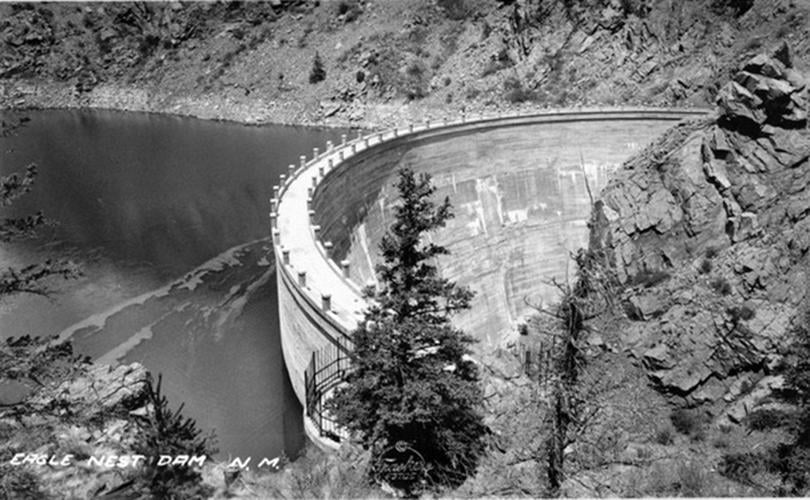
By the twentieth century, the federal government became heavily involved in answering that question. The Reclamation Act of 1902 funded massive irrigation and water-storage projects across the West. Dams and reservoirs could store water during wet periods, provide irrigation during dry ones, generate power, and help control flooding. The Theodore Roosevelt Dam on Arizona’s Salt River was completed in 1911. The Colorado River Compact of 1922 divided the river’s allocated water among seven basin states. Hoover Dam followed in the 1930s, creating Lake Mead and helping support the explosive growth of communities throughout the desert Southwest.
New Mexico got some major infrastructure of its own. Elephant Butte Dam, completed in 1916, became a major storage facility on the Rio Grande, providing water for irrigation in New Mexico and Texas while also helping fulfill deliveries to Mexico. And then there are the flood-control projects. For much of the nineteenth and early twentieth centuries, the Rio Grande regularly spilled out of its banks. Flooding was a natural part of the river’s cycle, but as Albuquerque grew, and the San Felipe Parish had to rebuild multiple times, “the river occasionally floods your city” became somewhat less desirable. After World War II, levees were constructed to protect Albuquerque from flooding. But there was an additional problem: during natural floods, the Rio Grande carries enormous amounts of sediment and can chip away at its banks, changing its course as it goes.
Which brings us to one of the more delightfully strange pieces of Rio Grande history: jetty jacks. If you’ve walked along the Bosque in Albuquerque, you’ve seen them. After World War II, there was a large surplus of the metal structures used by the military to create temporary roads and stabilize terrain. Some were repurposed for river management. Placed along the riverbanks and connected with wire, the jacks were designed to catch larger debris, which would then trap smaller sediment, which would eventually build up soil.
Let’s get back to this week’s rain, and the question I asked myself while I watched my toddler inspect the arroyo. If there’s water in the reservoirs, why isn’t it just released into the Rio Grande when the river is dry? The answer is: water management is complicated. Earlier this month, more than 650 million gallons of water owned by the Albuquerque Bernalillo County Water Utility Authority were released from Abiquiu Reservoir into the Rio Grande. The goal wasn’t to permanently refill the river. The temporary release allowed managers and conservation groups to study how water moved through the dry riverbed and shallow aquifer, while also providing a brief boost to the bosque ecosystem. And then it was expected to return to mostly dry conditions. Which sounds absurd until you remember that we’re talking about the Southwest. And then came the rain.
After one of the driest summers in New Mexico’s history, the recent storms have been wonderful news for wildlife, farmers, and anyone who has been staring longingly at a cloud for the last several months. But is it enough? Unfortunately, not really. Much of the rainfall has been absorbed into the ground. For farmers to have enough water to finish the irrigation season, considerably more water would need to arrive in a relatively short period of time. Still, the rain has provided some immediate relief. For the first time in quite a while, the Middle Rio Grande Conservancy District has been able to make some irrigation deliveries, with tributaries around Socorro seeing particularly significant benefits.
So, after all this talk about drought, reservoirs, canals, dams, aquifers, irrigation, flood control, acequias, and prehistoric waffle gardens, I suppose the lesson is pretty simple: Water management in the Southwest has always been about making the most of what you get. Sometimes that means building an enormous canal. Sometimes it means constructing a dam. Sometimes it means maintaining an acequia with your neighbors. Sometimes it means putting a bunch of jetty jacks in a river and hoping they cooperate. And sometimes, it means putting your toddler in a raincoat and watching him stare at the rain like you’ve just introduced him to the eighth wonder of the world….. and you probably did. Because here in the Southwest, we know better than most that when water finally arrives, you pay attention. And preferably, you keep your toddler out of the arroyo.
Soaking it in,
Mountain Girl
 Mountain Girl Goes
Leave a comment