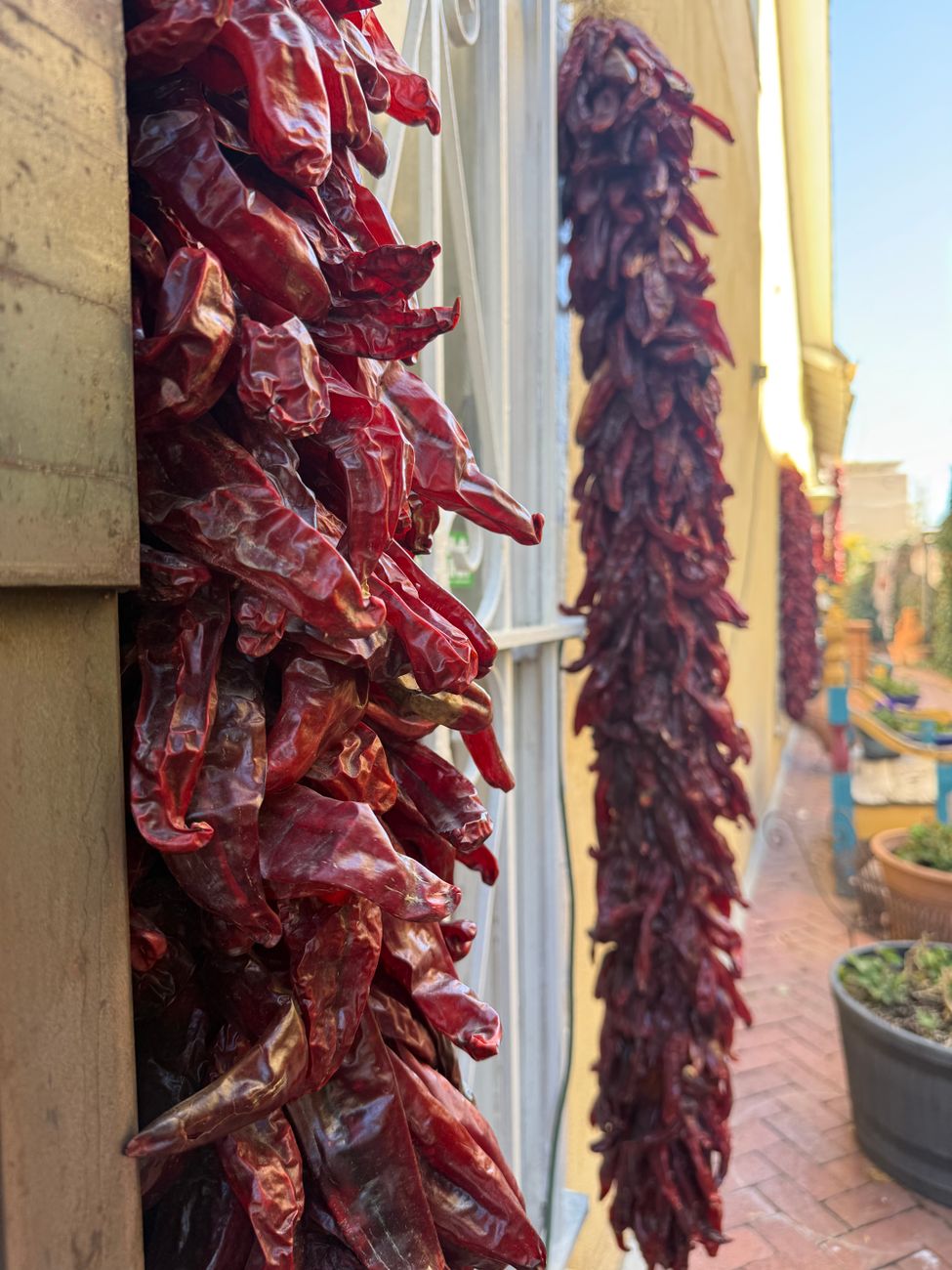
If you’ve ever been to New Mexico – or Arizona or California….. the more arid parts of the Southwest in general – you’ve more than likely come across a ristra. You know the ones I mean: strings of bright red chiles hanging from wooden beams (vigas), fences, kitchen walls, doorways, windows, and anywhere else it makes sense to stick a nail. They show up especially in the fall, when the chile harvest is in full swing and farmers’ markets and roadside stands procure the dried red peppers dangling from every available surface.
Ristras are beautiful strings of chile pods tied together and left to dry. Today we find them strung along in Taos, Santa Fe, and Albuquerque as decorative gifts for tourists to take home to their families (but watch out if you don’t live in an arid climate – you may want to have it lacquered). While a lovely decoration for your porch, their original purpose was considerably more practical: to preserve the harvest. Before we have food processors, dehydrators, air fryers, or the ability to open a can of red chile enchilada sauce, people had to figure out how to keep food from spoiling five minutes after it left the ground. Fortunately, New Mexico provides an excellent natural dehydrator in the form of sunshine, low humidity, warm days, cool nights, and a nearly perpetual breeze. In other words, even if you don’t want something to dry out, New Mexico is there to do it for you (although, cereal does take forever to stale..… bonus!).
Chile has a long history in the Americas: Capsicum was grown throughout much of the region long before Europeans arrived, and Spanish explorers in the late 16th century recorded accounts of Native American communities growing chile – specifically in the area that would become known as “New Mexico.” Indigenous peoples had already been cultivating and using chile, and Spanish settlers later brought additional varieties and culinary traditions. Over time, those influences became part of the distinctly New Mexican chile culture we know today. There are hundreds of varieties grown in the state, including jalapeños, cayenne, and our beloved New Mexican chile. And that familiar green chile? It’s not actually a completely different fruit from red chile. A chile pod starts out green. If you leave it on the plant longer, it matures and turns red. Green chile is generally harvested while the fruit is still green, while red chile is allowed to ripen before being harvested, then strung up and dried (interested in more chile facts?). As the ristras dry, the chiles darken from their brilliant harvest red into a deeper, subtler shade. At that point, they can be used in cooking. The dried pods can be rehydrated and turned into red chile sauce, added to stews and tamales, or ground into chile powder (look out for next week’s blog: we’re making posole!).
Which brings us back to the ristra. Originally, chile could simply be laid out in the sun to dry. This sounds reasonable until you remember that New Mexico is also home to birds, rodents, dust, and approximately one million other things that would be delighted to investigate your carefully prepared food – luckily red chile is a natural insect deterrent. So people began tying the chiles together and hanging them up off the ground. Problem solved. The chile could dry in the warm, dry air while staying safely away from curious critters. Eventually, somewhere along the way New Mexicans looked at the practical method of food preservation and thought, “Eee bro, that looks all sick.” And honestly, they weren’t wrong. There is something wonderfully beautiful about a ristra hanging against an adobe wall. The bright red peppers against the earth tones of an old building, with a turquoise door or a few hollyhocks nearby? It screams New Mexico without saying a word.
Ristras have also taken on symbolic meanings. They are commonly associated with good health, good luck, abundance, protection, and hospitality. A ristra hanging near a doorway can be seen as an invitation to visitors – a colorful New Mexican version of a welcome mat. There are also traditions that associate ristras with protection from evil or with bringing an abundant harvest in the coming year.
One of my favorite things about ristras is that they sit right on the line between useful and beautiful. They can be a decoration, a good-luck symbol, a welcoming gesture, and a future meal all at the same time. Honestly, something we should all strive for, am I right? New Mexico has a tendency to make practical things beautiful. Adobe walls aren’t just walls; they’re part of the landscape. A courtyard isn’t just a courtyard; it’s a place to grow flowers, gather with family, and escape the summer heat. And a string of dried chile isn’t just a way to preserve food – it becomes something you hang proudly outside your home. Of course, eventually, someone has to eat the decorations.
So when you see a ristra hanging from someone’s porch this fall, don’t assume it’s merely there to look pretty. It may be..… but it might also be dinner. That’s the thing about New Mexico. Our history is often hanging right there in front of us – sometimes literally. A ristra is a little bit of agriculture, a little bit of history, a little bit of art, and a whole lot of food, all tied together with a string and topped with a bow….. corn husk “hat” is the correct term, actually.
So this fall, when you see those bright red strings of chile hanging outside homes, markets, roadside stands, and old adobe buildings, take a minute to appreciate them. They’re not just decoration. They’re a harvest preserved, a tradition continued, a welcome offered – and, eventually (hopefully) a pretty darn good bowl of red chile.
You wanna get some chiles, or what?
Mountain Girl


Leave a comment