If you’ve spent any amount of time in the Southwest (New Mexico specifically), you’ve probably heard the word aceqiua (Ah-say-key-ah). Maybe you’ve driven alongside or over one, or heard the locals talk about the limpia, whatever that means. Now, if you’re looking to read the explanation of the legal maze that is southwest water rights, I’m not your girl. Water law in New Mexico (and Arizona and Colorado) somehow manages to be even more confusing than Spanish land grants, and that’s saying something. I can point you toward a stack of books if you’re feeling adventurous, but I also recommend keeping a bottle of Advil nearby.
Instead, I’ll write about something more interesting….. to me at least: the history of the acequia itself and why these humble irrigation ditches are one of the most important, and appreciated, practices in New Mexico’s history.
At first glance, this might be a boring topic. I mean, it’s just an irrigation ditch that diverts water from a river to nearby fields, gardens, and homes. Simple enough… until you realize you’re looking at the oldest continuously operating water management institution in the United States. In fact, the word acequia comes from the Arabic al-sāqiya, meaning “water conduit” or “the one that brings water to the land.” That got me wondering if Albuquerque’s original spelling—Alburquerque—might also have Arabic roots, since the Arabic word for apricot is al-barqūq. History is funny like that. Sometimes one little ditch can lead you down an international rabbit hole.
Today, roughly 600–700 acequias are still operating throughout New Mexico, especially in the northern part of the state. They continue to irrigate farms, replenish groundwater, support wildlife, and preserve a way of life that has survived for centuries. Not bad for “just a ditch.”
Acequias have an origin story that stretches back thousands of years to the Middle East, where civilizations learned how to transform arid desert landscapes into productive farm land though carefully managed irrigation. Centuries later, when the Moors occupied Spain between 700 and 1492, these irrigation techniques spread through the Iberian Peninsula. The Spanish adopted not only the engineering but also the philosophy that water should belong to the community rather than to individuals.
Then came 1598, when Juan de Oñate established the first permanent Spanish colony in New Mexico, one of the very first tasks wasn’t building houses or churches—it was digging an irrigation ditch. After all, a settlement without water wasn’t much of a settlement. Upon coming up from Mexico, the Spanish weren’t introducing irrigation to a place that had never seen it before. For centuries, Pueblo peoples had already mastered farming in an unforgiving desert. They built reservoirs, dams, diversion channels, and carefully managed runoff long before Europeans arrived. Spanish settlers brought a formal legal structure and governmental organization, while Indigenous communities contributed generations of local knowledge about farming this landscape. The result wasn’t one culture replacing another. It was a remarkable blending of two traditions that created the acequia system we know today.
Acequias are not just an engineering project: they’re a system of government. In fact, many historians consider the acequia commission to be one of the oldest continuously functioning democratic institutions in the United States. Every acequia is overseen by a commission and a mayordomo, or ditch boss. Now before you picture someone barking orders with a shovel over their shoulder, the mayordomo’s job is much more important than simply maintaining the ditch. They’re elected by the parciantes—the people who own water rights along the acequia—and they’re responsible for deciding who receives water, when they receive it, and how much they’ll get. During droughts, they also settle disputes between neighbors. Imagine trying to decide who gets water when there’s only enough for half the valley. No pressure.
One of the beautiful aspects of the acequia system is that wealth doesn’t determine influence. Whether someone owns one acre or one hundred, every parciante gets one vote. That’s a remarkably democratic idea for a system that’s over four centuries old.
The acequia itself is surprisingly simple. A small dam, called a presa, diverts water from the river into the acequia madre, or “mother ditch.” Smaller gates, called compuertas, direct water into individual fields before unused water eventually returns to the river through the desagüe. Gravity does almost all the work. No pumps. No electricity. Just careful engineering that’s been refined over hundreds of years.
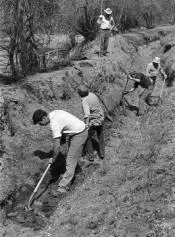
But perhaps even more important than the water itself is a tradition that occurs every spring. Before irrigation season begins, communities gather for La Limpia: the annual cleaning of the ditch. Everyone pitches in. Silt is shoveled out, brush is cleared, debris is removed. If you don’t help clean the ditch, you don’t receive water… or you might be paying a fine instead. Sure, it’s work. But it’s also a community gathering. Neighbors catch up after the winter, stories are exchanged, and the annual rhythm of rural life begins again. It’s hard not to admire a system where maintaining your shared resources is everyone’s responsibility.
One of my favorite firsthand descriptions comes from mountain man Lewis H. Garrard, who visited Taos in 1847. He described the valley as one enormous cultivated field, crossed by countless irrigation ditches carrying snowmelt from the mountains. Wheat and corn flourished thanks to these carefully managed waterways. He also noted that much of the wheat eventually became the legendary “Taos Lightning” whiskey… If you’ve read some of my previous blogs, you can probably guess where (or who) my mind immediately went. Perhaps young Mr. Garrard happened to run into Uncle Dick and sampled a little too much of that famous local beverage. History has a funny way of connecting stories.
Upon becoming a United States territory in 1848, the way people viewed water began changing. Instead of being primarily a shared community resource, water increasingly became something to own, buy, sell, and legally defend. Today, water rights remain one of the most complicated (and fiercely debated) subjects in the Southwest. Yet the acequia continues to remind us of an older philosophy. Water isn’t just a commodity, it’s a shared responsibility. These ditches recharge aquifers, support wildlife, create green corridors across otherwise dry landscapes, and keep small farming communities alive. They’re also recognized by the State of New Mexico as political subdivisions, giving them a unique legal standing that acknowledges just how important they remain.
Of course, they face modern challenges. Development paves over historic ditches, communities lose water rights, and younger generations often leave rural villages. Even so, there’s been renewed interest in preserving acequias as people recognize that these centuries-old systems may offer surprisingly modern solutions for living sustainably in an increasingly dry climate. Acequias aren’t simply relics from the Spanish Colonial period. They’re living history. They’re evidence that survival in the Southwest has always depended on cooperation rather than competition. They’re proof that Indigenous knowledge and Spanish traditions blended to create something uniquely New Mexican. Most of all, they’re a reminder that communities thrive when people work together.
So the next time you cross one of those quiet little ditches running alongside a road in northern New Mexico, don’t dismiss it as a glorified trench. You’re looking at centuries of engineering, democracy, tradition, and perseverance flowing gently downhill. Because acequias aren’t really about water. They’re about home. They’re about heritage. And in a place where every drop counts, they’re about life itself.
Sin agua, no hay vida,
Mountain Girl


Leave a Reply