It has been hot in Albuquerque this summer. And I’m not talking “just wear a tank top,” hot, I mean “you could probably bake those cookies on your dashboard,” hot. The kind of weather that when you open your front door, it feels like someone blasted you with a heat gun. Unfortunately, New Mexico’s favorite cooling system (swamp coolers) leaves something to be desired. Fortunately, the consultation prize for surviving the heat is aguas frescas!
If you grew up anywhere around New Mexico or Texas like me, you’ve probably seen the giant clear plastic (sometimes glass) drink dispensers full of a variety of colored drinks at farmers’ markets, fiestas, food trucks, and Mexican restaurants. Everyone had their favorites: my son loves sandia (watermelon..… Although he also likes any other flavor he can steal drinks from), my husband orders agua de pina (pineapple) every chance he gets (assuming he can find the sometimes elusive flavor), but I’m firmly Team Horchata.
My fixation on horchata began when I was about 12 or 13 years old. My best friend and her family took me with them to Santa Fe for the day, and we stopped at El Paisano, a Mexican grocery store with an incredible food counter. I got the carne asada street tacos – the right way: served with chopped white onion, cilantro, lime wedges, and salsa on the side – and a horchata. It changed my life. Okay, maybe that’s a slight exaggeration… but the tacos were phenomenal, but that cold, creamy, cinnamon-y drink alongside them was clearly unforgettable. I’ve been ordering horchata ever since. That same trip also included me, my best friend, and her sister consuming an entire barrel of cheese balls during the two-hour drive home. No regrets.
So, of course, now we have to ask the question: where did this super yummy drink come from? Well, no surprise to me, we’re visiting the Moors again, but the drink actually starts much earlier than the Moorish rule of the Iberian Peninsula. Archaeologists have found evidence of horchata-like drinks in ancient Egypt dating back to around 2400 B.C. When the Romans conquered Egypt, they adopted the beverage and referred to it by the Latin word hordeāta, meaning “barley-based drink.” Fast forward to the early 700s, when Muslim rule spread into southern Spain. Along with advances in science, architecture, agriculture, and mathematics came a little plant called the chufa, better known as the tiger nut. The region around Valencia turned out to be perfect for growing chufa, and before long people were soaking, grinding, and straining the tubers to create a cool, refreshing drink. By the 1200s, the beverage had become known as horchata. It’s kind of fun to think that we’re sipping on a variation of the same drink Averroes (Ibn Rushd) may have had while defending Aristotelianism (#HistoryNerd).
Spain still serves traditional horchata made from tiger nuts today, especially around Valencia. But like so many beloved foods, horchata packed its bags and crossed the Atlantic with the Spanish. The problem was that the tiger nuts didn’t make the journey with them. Since chufa isn’t found in Mexico, people adapted the recipe using ingredients they did have available. Rice became the perfect substitute, and over time the Mexican version we know today was born. Instead of tiger nuts, Mexican horchata is usually made with rice, cinnamon, sugar, and vanilla. Many families also add milk or sweetened condensed milk for an extra creamy texture, although some recipes stick to water alone.
It’s also just one member of the much larger agua fresca family. Depending on where you are, you might find drinks made from watermelon, pineapple, cantaloupe, hibiscus flowers (jamaica), tamarind, pecans, or just about any fruit, grain, or seed you can imagine.
Today, horchata has become more than just a drink. For many it’s tied to birthday parties, Sunday lunches, neighborhood restaurants, and summer afternoons. Recipes get handed down, adjusted, debated, and perfected.
I think that’s part of why food history is so much fun. It’s easy to think of recipes as things that don’t change – as if they were invented once and everyone has followed the same instructions ever since. In reality, recipes travel with people. They adapt to new climates, new crops, new cultures, and new tastes. A drink that started thousands of years ago eventually found its way to Spain, crossed an ocean to Mexico, and somehow ended up in a big jug at a grocery store in Santa Fe. That’s quite the journey for a glass of cinnamon rice milk.
Horchata Recipe:
Ingredients
- 1 cup uncooked white rice
- 2 cinnamon sticks, slightly crushed (I had my 3-year-old jump on mine, but if you don’t have one of those I guess a rolling pin works)
- 4-6 cups water*
- 1 can evaporated milk*
- 1 can sweetened condensed milk*
- ½ cup sugar (withhold if using sweetened condensed milk – see end notes)
- ½ teaspoon vanilla extract (optional but recommended)
- Ground cinnamon, for garnish
Instructions
- Combine the rice, cinnamon sticks, and 4 cups of the water in a bowl. Cover and refrigerate overnight (or at least 4–8 hours).
- Remove most of the cinnamon sticks, leaving a few small pieces behind.
- Blend the soaked rice mixture in two batches until very smooth, about 3–4 minutes per batch.
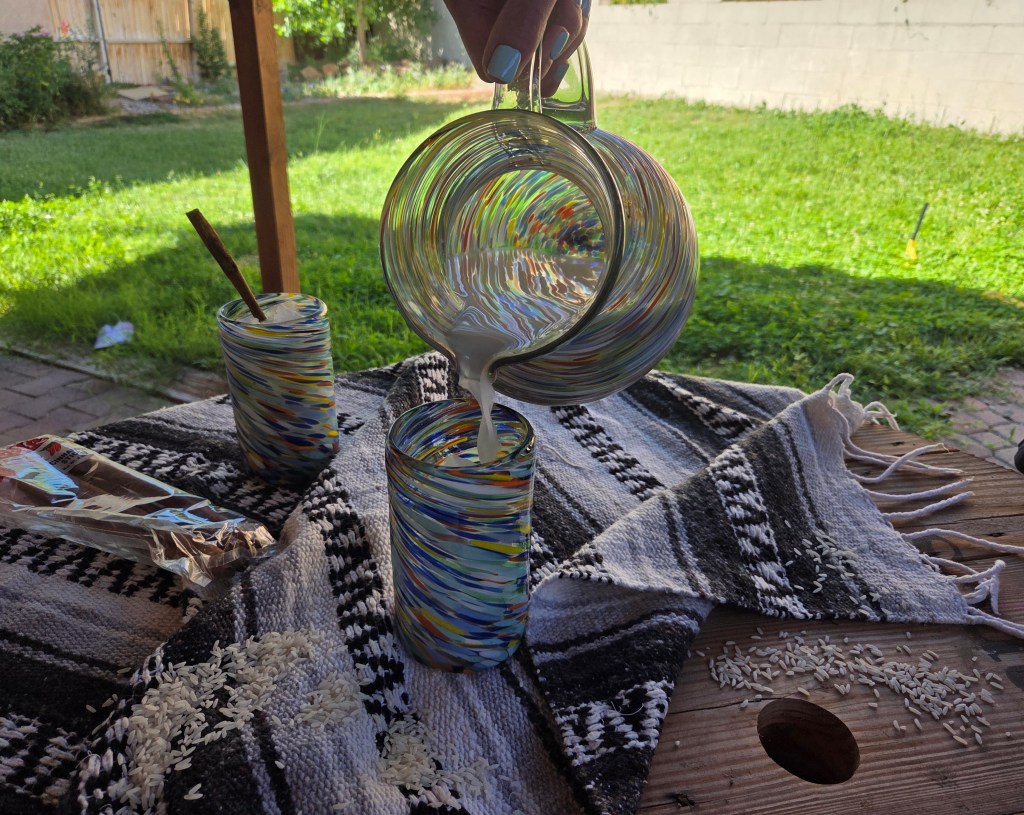
- Pour the mixture through a fine-mesh strainer or cheesecloth into a large pitcher, pressing on the solids to extract as much liquid as possible. Discard the remaining rice pulp.
- Stir in the sugar and the remaining 2 cups of water until fully combined OR evaporated milk and sweetened condensed milk (if using), and vanilla.
- Taste and adjust with additional sugar or a little extra water if you’d like it sweeter or lighter.
- Chill well before serving. Give it a good stir before pouring, as some rice sediment will naturally settle.
- Serve over plenty of ice with a sprinkle of ground cinnamon.
*Want a more traditional version? Simply replace both canned milks with 2 additional cups of cold water for a lighter, dairy-free horchata that’s closer to the style commonly enjoyed in parts of Mexico.
Salucita,
Mountain Girl


Leave a Reply