A nun and a cowboy walk into a bar….. wait, that can’t be right. Let me try again. This story sounds like someone combined a hagiography and a script for a Western, and decided, “Sure, that seems plausible.” Only then to discover that it’s actually true! Enter, Sister Blandina Segale.
Born Maria Rose Segale in Italy in 1850, she and her family immigrated to America in 1854. At sixteen, she joined the Sisters of Charity in Cincinnati, and just six years after that she was sent to Trinidad. Naturally, she assumed her superiors meant for her to go to the Caribbean. Instead, she found herself traveling the Santa Fe Trail to Trinidad, Colorado Territory. A far cry from blue water beaches and palm trees swaying in the tropical breezes. She later wrote in her journal (which she kept for her sister, Justina) “Here I am safe in Trinidad, Colorado Territory, instead of an island in Cuba where I first thought I was to go. No wonder this small pebble is not on our maps.”
Imagine being 22 years old, leaving home to head into what was still very much the Wild West….. although, I suppose that’s how many recent college graduates feel today. The trip alone would’ve tested anyone’s nerves. However, before leaving Ohio, a well-meaning gentleman had assured her that “no virtuous woman is safe near a cowboy.” That’s comforting. Riding in a stagecoach across the southeastern Colorado plains, Sister Blandina later wrote she had been terrified.
One night on this journey, after the coach stopped for supper (fear prevented her from eating), a hitchhiking cowboy climbed aboard. Unfortunately, Sister Blandina must’ve read enough dime novels to convince herself this was probably how Western murders began. She even shifted her body so that, if he decided to shoot her, he’d have a clear shot through the heart. She later wrote of the suspense, “The agony endured cannot be written.” But instead of pulling out his gun, the cowboy simply asked, “What kind of lady be you?” After explaining that she was a Sister of Charity she asked why he’d become a cowboy. He told her he’d run away from home after reading stories about the West. She then asked the question every runaway and cowboy secretly dreads:
“Have you written to your mother?”
“No, madam,” he admitted. “And I allow that’s beastly.”
She told him to write to her immediately after leaving the stagecoach.
“I will, so help me God!”
The exchange with the cowboy in the stagecoach became the standard for how Blandina lived life on the frontier. She treated everyone—cowboys, outlaws, prisoners, Native Americans, politicians, orphans, and school kids—as human beings worthy of dignity.
Enter Billy the Kid. Born Henry McCarty in 1859, Billy’s family moved to Silver City, New Mexico in 1873. After drifting toward the wrong side of the law, he became involved with John Tunstall’s ranch and, eventually, the Lincoln County War. (You may remember my previous blog on that particular mess.)
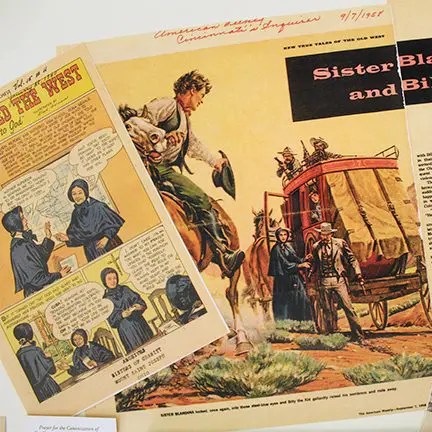
By the time Sister Blandina encountered him, Billy the Kid was already one of the West’s most notorious outlaws. According to her account of their first meeting, a member of Billy’s gang had suffered a gunshot wound at none other than Uncle Dick Wooten’s tollgate coming up from Cimarron – now how would a self-respecting, dignified young man come across an injury like that? Several doctors in Trinidad refused to provide treatment, so Sister Blandina cared for the wounded man until he recovered. In the meantime, Billy plotted a reasonable solution….. he’d simply have to scalp the four doctors. When he arrived in Trinidad, he greeted the nun warmly, having heard how she looked after his friend. “We are all glad to see you, Sister,” he told her. “I want to say, it would give me pleasure to be able to do you any favor.” Sister Blandina knew exactly what to ask: she took his hand and said she understood he’d come to scalp the town’s physicians and could he please… not? He looked at his buddy and said, “She is game..… I granted a favor before I knew what it was, and it stands.” Just like that. Years of law enforcement struggled to control Billy the Kid. A twenty-something nun simply asked nicely.
This wasn’t the end of their unusual friendship. On another occasion, Sister Blandina was traveling by stagecoach when a band of riders appeared. The passengers feared they were about to be robbed. She adjusted her bonnet to get a better look at one of the horsemen. Their eyes met and Billy recognized her immediately. He tipped his hat, bowed politely, and rode away, calling off the robbery.
A couple years later, another encounter: traveling across the plains between Las Vegas, New Mexico and Trinidad, Sister Blandina was with some men who were greatly afraid of Billy and of course he was rumored to be nearby. If he was, she believed, he’d be carefully watching for any travelers coming through the plains. So she prayed the rosary on the open land at dusk to make it obvious to him that she was among the travelers. And when Billy passed them the next day, he waved his hat in the air and made his horse dance.
Their final meeting came after Billy’s capture following the Lincoln County War. Sister Blandina visited him in the Santa Fe jail, where his hands and feet were chained painfully to the floor. Whatever crimes he’d committed, she was saddened by the harshness of his condition, seeing not just the notorious outlaw but the young man whose better nature she had glimpsed several times before.
Billy the Kid was killed in July 1881 at the age of twenty-one. Just a few months later, on September 21 (ahem “Love was changin’ the minds of pretenders,”), Sister Blandina opened Albuquerque’s first public school. She would later help establish both public and Catholic schools throughout New Mexico, as well as hospitals, orphanages, and charitable institutions. Her convent still stands beside San Felipe de Neri in Old Town Albuquerque as a reminder of those remarkable years.
Of course, building schools and hospitals isn’t quite as flashy as befriending an outlaw, but you do what you gotta do. Later in life, she helped found St. Joseph’s Children’s Hospital in Albuquerque in 1900. She died in 1941 after a lifetime that somehow managed to combine education, healthcare, social justice, frontier adventure, and an uncanny ability to convince dangerous men to make better life choices… and to write their mothers. Hollywood eventually noticed. In 1966, Death Valley Days aired an episode called The Fastest Nun in the West, dramatizing one of her real-life confrontations with frontier injustice.
Sister Blandina is officially being considered for sainthood as of 2014. She now bears the title “Servant of God:” the first formal step on the path toward canonization. When people hear the word “saint,” they often picture someone quietly praying in a monastery, and Sister Blandina definitely prayed, but she also crossed the frontier by stagecoach, faced down lynch mobs, argued with politicians, comforted prisoners, founded schools, built hospitals, and apparently became one of the few people Billy the Kid simply couldn’t say no to.
Not bad for someone who thought she was headed to a Caribbean island.
You can read more about Sister Blandina’s canonization here, and read her journal, titled At the End of the Santa Fe Trail, here.
Go in peace,
Mountain Girl

 Mountain Girl Goes
Leave a comment