Every December in the Southwest, as the air becomes crisp and the smell of firewood permeates the evening, the sounds of singing, laughter, and knocking on doors begin to echo through neighborhoods. This is Las Posadas, a tradition that beautifully blends history, faith, and community in light of the Christmas season.
Las Posadas translates to “the inns” or “the lodgings,” and the name itself evokes thoughts of what it means to be welcome. Today, the tradition feels inseparable from Christmas in Mexico and the American Southwest, but the roots encompass much more, combining indigenous practices, biblical interpretation, and colonial history.
Coincidentally, the timing of Christmas aligns with the Aztec tradition honoring Huitzilopochtli, the god of war and sun, on the Winter Solstice. When the Spaniards arrived in Mexico, it was often easier to overlap Christian celebrations with the existing indigenous practices as a way to introduce natives to Catholic beliefs. As December was already a sacred season for the Aztecs, Christmas – and eventually Las Posadas – became a natural fit. What emerged wasn’t a replacement, rather a cultural blending of traditions (without the bloodletting and human sacrifices).
To understand Las Posadas better, let’s take a look at the Nativity story itself. In Luke 2:7, we’re told that Mary and Joseph found no room at the inn. The passage reads:
“And she brought forth her firstborn son, and wrapped him in swaddling clothes, and laid him in a manger; because there was no room for them in the inn.”
That line has fueled centuries of Christmas pageants, reenactments, and songs. Brace yourself, I’m about to nerd out a little bit – but in a cozy way.
Early translations of the Bible relied on the Septuagint, the Greek translation of the Hebrew Bible dating back to the 2nd century BC. The Greek word translated to “inn” in Luke 2:7 is kataluma, which can also mean “guest room” or “lodging.” Considering that later in Luke’s Gospel (10:34), a different word was used for “inn,” Mary and Joseph were probably not turned away by a grumpy innkeeper. More likely, they were searching for space among friends and family, all of whom were already packed tight thanks to the ordered Roman census. Most homes at the time had upper and lower levels, with the lower levels being used to house animals during cold nights. So the Holy Family was probably offered shelter here, rather than a cozier upstairs guest room. To me, this makes the story more human, and the idea of “seeking lodging” less dramatic and more tangible.
Fast forward to 1586, when Fray Diego de Soria, an Augustinian procurator in Mexico, received permission from the Pope to hold Christmas masses – misas de aguinaldo – from December 16 through 24. These nine days can represent two things: either the nine months Mary carried Jesus or the nine-day journey from Nazareth to Bethlehem. The celebrations began in churches, but soon spilled over into haciendas and private homes, thereby transforming Las Posadas into a neighborhood affair.
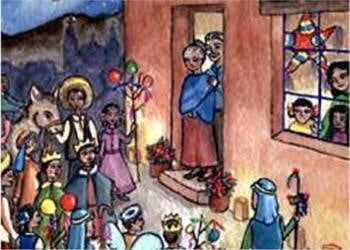
During the celebration of Las Posadas, two people (oftentimes children) dress as Mary and Joseph, while selected homes will take turns acting as the “inns.” The procession following the Holy Family moves through the streets, singing and rejoicing in the holiday season. At each house, a call-and-response song occurs – the hosts will initially deny lodging, the procession pleads their case, and the hosts eventually concede and let the group in.
Once inside, the guests gather around a Nativity to pray and reflect on a different virtue each night: humility, strength, detachment, charity, trust, justice, purity, joy, and generosity. These are not simply abstract ideas: they are meant to be lived, practiced, and shared, much like the hospitality shown by the hosts after the religious contemplation. Namely: food!
Fresh tamales, warm mugs of champurrado (recipes upcoming next week!), and children lining up to receive treats (oftentimes a masa and honey mixture borrowed from the days of the Aztecs) and to partake in the star-shaped pinata.
As Mexican settlers moved north, the tradition of Las Posadas came with them. Today, it’s a staple part of the holiday in Southwest states like New Mexico, Arizona, Texas, and Southern California, where luminarias light the way for singing processions. Churches often host large community Las Posadas, while families and neighborhoods keep things informal at home. The tradition may change a bit, but the heart stays the same.
At its core, Las Posadas is about welcome. It’s about remembering why we celebrate Christmas – that Mary and Joseph knocked on doors and waited to be welcomed, so they in turn could welcome the Son of God. In the Southwest – where cultures, histories, and landscapes collide – that message resonates. It’s a lighthearted celebration, yes, full of singing, food, and community, but it also carries the quiet reminder that the Holy Family, too, once needed refuge.
So if you happen to hear singing and see a large candlelit procession this week, don’t be surprised. Grab a candle of your own, pour something warm, and ask to join in! After all there’s always room to make room, and the inn is open.
Entren, santos peregrinos,
Mountain Girl

 Mountain Girl Goes
Leave a reply to From Aztecs to Abuelitas: The Cozy History of Champurrado – Mountain Girl Goes Cancel reply