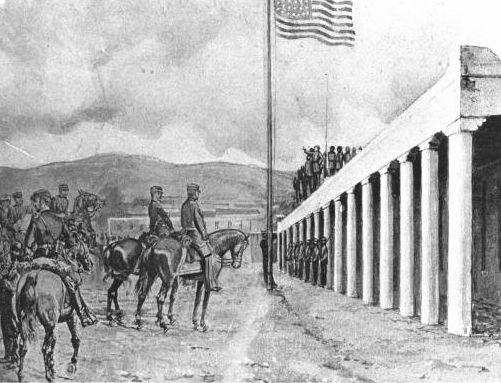
Can an event truly be called a battle if no gunfire was exchanged at any point? Well, one example is the Battle of Santa Fe. More accurately described as the Capture of Santa Fe, it occurred in 1846 during the Mexican-American War when the U.S. forces under General Stephen W. Kearny took the capital of New Mexico without bloodshed or resistance.
During this time, New Mexico was still under Mexican rule, and General Kearny was ordered to march his force – the Army of the West – of around 2,000 soldiers from Missouri to New Mexico (using the Santa Fe Trail!) to capture Santa Fe.
In June of that year, news of General Kearny’s approach reached the ears of the Mexican Territorial Governor of New Mexico, and the state’s last Mexican governor, Manuel Armijo. He caught wind of the Army of the West headed his way from James Magoffin, a well-known American trader who frequented the Santa Fe Trail and had many connections in the region. Magoffin (who later played a role in supplying Colonels Baylor and Sibley on their New Mexico expeditions during the Civil War) persuaded the Governor – perhaps with the help of others – to avoid military confrontation.
Prior to Magoffin’s convincing, Armijo had issued a proclamation on August 8th to prepare New Mexicans to repel the Americans, stating: “Behold, fellow citizens, the invasion is the sign of alarm that must prepare us for the combat… Let us be ready for war since we are provoked to it.” His spirit of defiance faded rather quickly: it was a few days later that he met with Magoffin, and promptly abandoned the city. According to legend when Armijo mounted his horse to flee Santa Fe, angry citizens (who wouldn’t be?) surrounded the Governor’s Palace. In order to escape, the resourceful governor threw handfuls of coins into the crowd, creating enough chaos and distraction to make his getaway to Albuquerque (interestingly enough, Santa Fe at around 4,500 people, was almost three times the size of Albuquerque).
Kearny already understood that people of Santa Fe would be fearful, and had issued orders to his men not to harm property or people – “a blade of grass nor an ear of corn,” were to be disturbed. The General’s orders came days before the Acting Governor Don Juan Bautista Vigil y Alarid sent him a letter advising him of his people’s apprehension.
On the evening of August 18th, 1846, General Kearny’s Army of the West completed their 821 mile journey from Missouri to Santa Fe and conquered the city without firing a single shot. Kearny himself later reported the capture occurred “without firing a shot, or spilling a drop of blood.”
Despite the lack of combat, the “battle” was a strategic victory for the United States, paving the way for further advances into the Southwest and cementing American control of New Mexico. Of course, throughout the duration of the Mexican-American War, not everything was as unusually peaceful as the Capture of Santa Fe (New Mexicans eventually resisted during the Taos Pueblo Revolt of 1847 – which I will touch on in a later blog post!).
So yes, the event is called a “battle..…” even though the only things flying through the air were coins, not bullets.
Adios Amigos!
Mountain Girl

 Mountain Girl Goes
Leave a reply to In Matters Vegetable, Animal, and Mineral: John C. Frémont, the Modern Major-General – Mountain Girl Goes Cancel reply