Nearly 150 years ago, on February 18th, 1878, John Tunstall was shot by Jesse Evans – and with that single shot, the Lincoln County War had officially begun. But as is the case with most wars (and family group texts), the drama had been brewing long before the trigger was pulled. So let’s back up.
Disclaimer: I am not a battle historian! I do not own a battlefield map. I cannot explain military formations of strategy. So this post is your friendly, and simplified, “Who’s mad at whom, and why?” guide to one of New Mexico’s most famous conflicts.
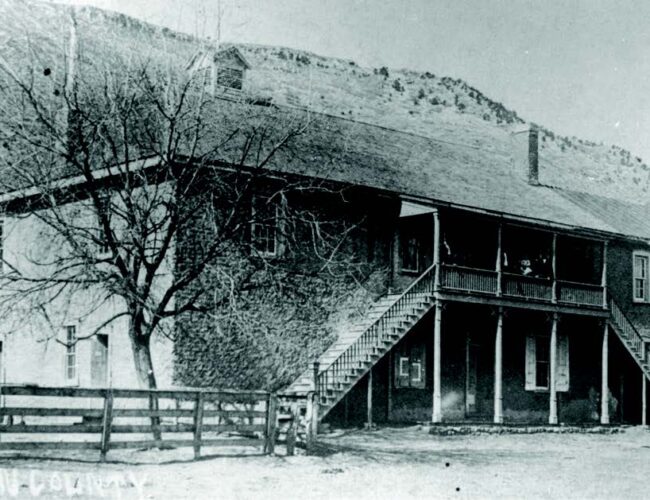
Let’s begin by picturing the 1870s New Mexico Territory: it was huge. Lincoln County itself was the largest county in the U.S.: roughly ⅕ of the territory sitting at about the size of West Virginia. It was remote, rugged, and full of cattle. And so, where there’s land, livestock, and very little regulation, there’s opportunity, and where there’s opportunity, there’s someone trying to corner the market. Enter “The House.” Run by two established businessmen, Lawrence Murphy and James Dolan, The House was a powerful mercantile monopoly controlling goods, credit, and livestock contracts across the region. Need supplies? The House. Need a loan? The House. Want to sell some cattle? The House. These men weren’t your average shopkeepers. They were also connected to the powerful political group known as the Santa Fe Ring – a network of powerful politicians, lawyers, and land speculators who took full advantage of the chaos following the Treaty of Guadalupe Hidalgo. And also that land grants, boundaries, and records (if they existed) were confusing. One of its most powerful members (the Ring Leader perhaps?) was Thomas Catron: banker, attorney, and territorial sleaze-ball deluxe.
Meanwhile, New Mexico’s governor at the time, Samuel Axtell, publicly denied the Ring’s existence in 1878. The newspaper The Albuquerque Review absolutely roasted him for his statement saying, “The poor man seems to think that he is charged with being in this ‘ring.’… Why bless your simple heart Sammy dear! They wouldn’t trust you to enter the first grade of apprenticeship in their systemized organization of rascality, because they don’t need you.” Ouch.
The House also enjoyed a cozy relationship with local law enforcement… more on that later.
In the other corner stood John Tunstall and Alexander McSween – two young businessmen trying to break up Murphy and Dolan’s monopoly. Backed by wealthy cattle baron, John Chisum (not to be confused with Chisholm), they aimed to introduce competition into Lincoln County’s economy. Threatening The House’s grip on everything, and irritating people who preferred not to have competition.
Working for Tunstall as a ranch hand (really as an informal bodyguard) was Henry McCarty, who at this point was going by William Bonney. You probably know him as Billy the Kid. On the other side, Murphy and Dolan had their own hired muscle: Jesse Evans and his gang. Tensions were anything but subtle.
The story begins: Tunstall allegedly refused to pay a disputed debt to Murphy. And when a posse showed up to his property to seize assets, Tunstall protested. On February 18th, 1878, he was shot and killed – most commonly attributed to Jesse Evans. Of course, following that, things escalated to “business dispute” to “frontier war.” As I mentioned before, local law enforcement was aligned with The House. There was little faith that justice would be served for John Tunstall. So Billy the Kid and Tunstall’s other ranch hands formed their own posse called The Regulators.
Their mission was simple: avenge Tunstall’s death.
One of The House’s allies, William “Buck” Morton, wrote on March 8th, “There are two parties at arms and violence is expected.” The very next day he was dead – killed by The Regulators. In April 1878, The Regulators killed Sheriff William Brady, who, of course, had been aligned with Murphy and Dolan. A few days later came the shootout at Blazer’s Mill, where Buckshot Roberts died in a fierce gunfight.
The conflict peaked in July 1878 during what would become known as the Battle of Lincoln. For five days, gunfire broke out over the main street of Lincoln. The Regulators on one side of the street, The House on the other. Eventually, the U.S. Army cavalry from Fort Stanton arrived to restore order. The conflict was seemingly at an end. It wasn’t. That night, McSween’s home was set on fire, and as he was trying to escape, reportedly with a Bible held to his chest, he was shot and killed by members of The House. With McSween dead and federal troops present, the fighting largely collapsed, but the story hadn’t ended.
The violence and corruption drew national attention. President Rutherford B. Hayes dismissed Governor Axtell (who, by the way, was corrupt and affiliated with the Ring, thank you very much The Albuquerque Review) and replaced him with Lew Wallace – former Union general and future author of Ben Hur. Wallace attempted to restore order and offered amnesty to many involved in the conflict. Billy the Kid did not make the list, and was convicted for the murder of Sheriff Brady. He escaped custody, returned to outlaw life, and became a folk legend….. for 3 months. In July 1881, at the age of 21, he was shot and killed by Sheriff Pat Garrett inside the Fort Sumner home of Pete Maxwell (Lucien Maxwell’s son). Supposedly, following the shooting, Garrett received quite the scolding from the Maxwell family’s servant, Deluvina.
It’s easy to reduce the Lincoln County War to yet another story about cowboys shooting each other, but at its core, it was a fight over economic control, political corruption, and who got to define “law” in a rapidly changing territory. The conflict is cemented in the mythos of the Wild West: blurred lines between outlaw and lawman, loyalty and vengeance, justice and revenge. History is rarely clean. It’s messy, human, and full of people making questionable choices under pressure….. a lot like parenting now that I think about it.
In the words of Billy the Kid, Quien Es,
Mountain Girl
 Mountain Girl Goes
Leave a comment