For centuries, cornbread has shown up on tables around the country in the most unassuming way, and yet always (for my family at least) becomes one of the focal points of the entire meal. Cornbread provides us with the proof that the simplest ingredients can give us some big stories. It’s humble, it’s golden, and it’s history in a cast-iron skillet.
Corn itself has been a staple in North America long before the Europeans arrived. Native Americans were cultivating corn and creating delicious recipes with the ingredient thousands of years ago (remember champurrado?), and even made early versions of what we think of as cornbread today. When the colonists arrived, they didn’t really choose corn, but rather accepted it as a means of survival. Wheat was difficult to grow and unreliable in the New World, while corn thrived….. and so did the people who allowed geography and necessity to guide them.
Corn’s influence wasn’t just felt by the Mid-Atlantic colonists! Spaniards learned from Native Americans how to make tortillas using corn rather than wheat and brought the knowledge back to Spain. Later, cornmeal became a staple food along the Middle Passage, sustaining enslaved Africans during their unimaginable journey and continuing as a dietary staple in the Americas. And so, corn became essential to survival across cultures, continents, and social classes.
Its importance continued to grow as wheat flour became a favorite export from the Mid-Atlantic colonies to England. Rural and poor communities leaned on cornmeal to supplement or replace wheat flour. In the American South, cornbread became a necessity, as wheat flour often spoiled quickly in the heat and humidity (honestly, me too).
As we all know, history likes to repeat itself. Again and again, America has had to turn away from wheat flour and into cornmeal’s arms. Early colonists struggled to grow it, then global demand sent it overseas. During World War I, wheat rationing gave rise to “War Breads” and food-conservation campaigns under the name “Hooverizing.” Housewives were urged to observe wheatless Mondays and Wednesdays, meatless Tuesdays, and porkless Thursdays and Saturdays (I think my mom must’ve been inspired by this meal plan when she first discovered she was Celiac!). Publications like Wheatless Recipes popped up, and families dusted off memories of childhood cornpone. The pattern repeated during World War II, and in 1946 Eleanor Roosevelt reflected on post-war wheat rationing, writing, “My mind reverts to the last war, when every housewife was asked to use cornmeal instead of flour for at least one meal everyday….. I still have many recipes for different types of cornbread which we used not only once a day, but often twice.”
So what is cornbread, really? Today, it could be considered a deeply personal food. Ask ten people what belongs in cornbread, and you’ll get ten different – and confident – answers. Sugar or no sugar? Yellow or white cornmeal? Flour or absolutely not? And if you decide to use a box mix, which one is the best? (For the record, the correct answer is Jiffy Corn Muffin Mix, which debuted in the 1930s under the slogan, “So easy even a man could do it.”)
Cornbread is so deceptively complicated that it doesn’t even go by one name! Johnny cakes, fry bread, hushpuppies, spoonbread, hoecakes, arepas – all count. Each version reflects a different culture, place, and moment in time. In the search for “authentic” cuisine, it’s worth remembering that authenticity doesn’t live in a single recipe, but in history and adaptation. In the northern states, cornbread was often its “truer” form to how the European settlers learned from their Native neighbors: simple and hearty. In the South, folks started experimenting a little more, adding buttermilk, different sugars, and eggs. Regional variations had formed!
The contrast between the traditional Native American use of corn and the Western-influenced adaptations emphasizes how food is shaped by geography, politics, and social changes. Cornbread is not only nourishing – it brought people together in shared customs and crossed class divides. “Food is the great equalizer,” and corn became the common thread running through the national diet. Cornbread, in particular, could even be viewed as a symbol of resilience and adaptability. Recognizing its heritage allows for a deeper understanding of who we are and how we got here.
Today, cornbread is no longer a food of necessity, but one that provides comfort. It sits beside chili, stews, ham, barbeque, and collard greens. It’s crumbled into bowls, slathered in butter and grape jelly, and drizzled with honey. My favorite way to eat cornbread is broken up into a bowl with warm milk and honey (an easy Indian Pudding, as I’ve realized recently….. drop a comment if you’d like a food history and recipe post on that dish!). But honestly, you won’t see me turn down any variation, it’s all delicious.
Ingredients:
1/2 stick butter
1 1/3 cup flour
1 cup yellow cornmeal
6 Tablespoons sugar
2 Tablespoon baking powder
1/2 teaspoon salt
4 eggs
2/3 to 1 cup buttermilk
- Preheat oven to 400° and place a 10-inch cast iron skillet inside with the butter. Whisk together dry ingredients (you can also sub all the dry ingredients for 2 boxes of Jiffy!). Whisk together buttermilk and eggs; stir into cornmeal mixture just until combined (a little bit thicker than pancake batter – adjust buttermilk if needed). Pour batter into hot skillet.
- Bake at 400° for 25 to 30 minutes or until golden and cornbread pulls away from sides of skillet. Invert cornbread onto a wire rack; serve warm.
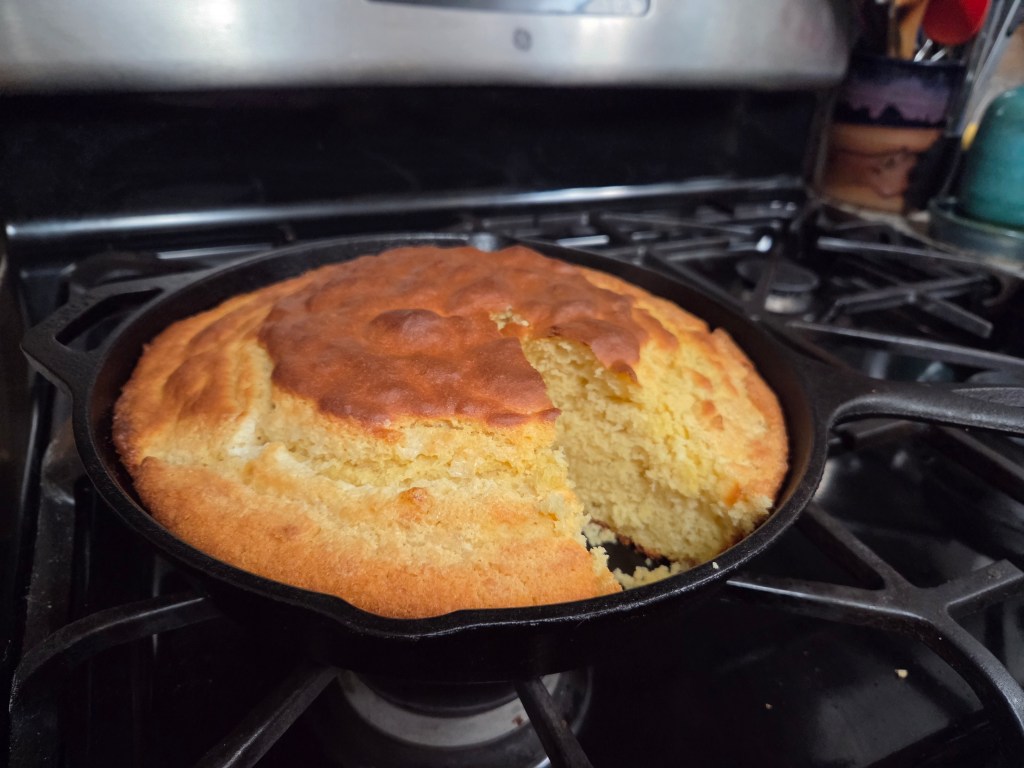
Full disclosure: in my current leaky-brain pregnant state, I accidently used masa harina instead of corn meal. I could not figure out why it was soaking up the buttermilk so quickly! Anyway, when I finally realized what happened, it was in the oven. It turned out so yummy! Quite a bit fluffier than a traditional skillet cornbread, but I highly recommend duplicating our newly dubbed “skillet corncake.”
How do you like your cornbread?
Mountain Girl
 Mountain Girl Goes
Leave a comment