When I was little, my mom started the genius tradition “Culture Sundays.” These outings usually involved a museum, a historical site, or a place where touching things was usually discouraged. And I loved it. These Culture Sundays did something to me, because I love museums. Like, will happily arrange an entire vacation around museums kind of love. Which brings me to my honeymoon.
When my husband and I went to Las Vegas, Nevada, we spent a majority of our time hoping around museums, historic sites, and outdoor activities….. between all good food we could find, of course. Luckily, I married someone who likes to vacation similarly to me, so it didn’t take much convincing to get him on board with the plan. Of all the places we visited, I’ve been itching to go back to explore more of the Old Mormon Fort.
Unfortunately, with a three-year old and a baby on the way, a Vegas trip isn’t in the cards right now (of course that pun was intended). So instead of taking the long drive over to Sin City, I’m going to do the next best thing: tell you all about that first permanent structure in what would become Las Vegas.
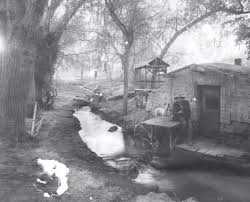
Long before neon lights, slot machines, and drive-thru chapels, the Las Vegas Valley was defined by something far more precious: water. A spring-fed creek flowed through the area, creating an oasis in the middle of the Mojave Desert. Unsurprisingly making it a destination sought out long before the Golden Gate Casino opened its doors in 1906. The first to people to be attracted to live in and utilize the area were the Ancestral Puebloans and Southern Paiute. Later, emigrants, traders, and gold seekers traveling along the Old Spanish Trail to California passed through. Spaniards and Mexicans dubbed the area Las Vegas, or “the meadows.” So while the Old Mormon Fort was the first permanent structure, its builders were far from the first people to call this place home – or even camp.
Explorers passed through as well! Antonio Armijo, a Mexican trader and believed to be the first person to have reached Los Angeles from New Mexico, camped there the winter of 1829-30. In 1844, John C. Frémont – yes, the very same from last week – traveled through the valley, noting the Old Spanish Trail in his journal, and labeled “Vegas” on his map. This is the first known map to name Las Vegas, and yes, Fremont Street is named in his honor (a fun fact for you history nerds to annoy your friends with next time you go!).
In June of 1855, a group of 30 Mormon missionaries led by William Bringhurst arrived in the Las Vegas Valley with a plan. They built an adobe fort alongside the Las Vegas Creek, intending to both convert the Paiute people and to establish a way station between Salt Lake City and California – specifically the San Bernardino Mission.
The fort itself was no small feat. Four walls at about 150-feet each, two bastions, and a row of two-story interior buildings. All built in the middle of the desert… in the middle of summer. My mom thought I complained about the heat when she took me when I was 16… let’s all take a moment to appreciate the missionaries’ commitment to their cause.
At first, things went well. Brigham Young even called for a second group of missionaries – this time including women and children – to join the mission. The first post office in Las Vegas opened August 21, 1855, with the very specific name “Bringhurst’s Post Office, Unknown County, New Mexico.” (Las Vegas was then a part of the New Mexico Territory for any of you interested in trivia.) In 1856, the first school was established for all children in the area, including the Native American children, which was notable for the time.
Missionaries worked with the Native Americans to aid in farming and shared their religious teachings, and many were baptized. One missionary, John Steele, wrote about their first Independence Day there:
“The company paraded at the dawn of day and fired a salute very spiritedly; also at sun-up and again when the liberty pole was erected and the flag floated majestically to the breeze….. Afterwards there were many spirited speeches, songs, and toasts from many of the brethren. Then all were dismissed by prayer and went to perform our several camps duties.”
Sadly, the good times didn’t last. While the missionaries managed to grow a variety of crops, maintaining them proved difficult. The desert climate, ongoing tensions and conflicts with the Native Americans, leadership disputes, and repeated failures on the lead-mining efforts took a toll. In early 1857, Brigham Young made the call to close the mission, stating “this station becomes an expense to the kingdom, and as at present seems, not to add any honey to the hive.” A very nice way of saying “this isn’t working out.” And so, the missionaries abandoned the fort, but its story had just started.
In 1861, shortly after the Mormons left, the fort found new life as a store for travelers under Albert Knapp. The Knapp Store supplied fresh produce and goods to miners and other desert travelers passing through. Once again, Las Vegas proved itself a critical stop in an unforgiving landscape.
Then, in 1865, Octavius Decatur Gass acquired the site and turned it into a ranch. Gass was a major figure in the region, serving four annual terms in the Arizona Territorial Legislature and supplying food to miners at El Dorado Canyon and Mormon settlers in St. Thomas. Unfortunately, after failing to repay a loan, he lost the ranch in 1881 to Archibald Stewart.
Stewart moved his wife and four children to the property, but his time there was short. In 1884, he was killed in a gunfight at the nearby Kiel Ranch, leaving his pregnant wife, Helen, in charge of the property.
Helen Stewart was an impressive woman, and didn’t just survive, but thrived. She successfully kept the ranch running for two decades, managing livestock, land, and business in an era when women rarely did – or were given credit for – such things. Today, she is known as the First Lady of Las Vegas. In 1902, she sold the property to the San Pedro, Los Angeles & Salt Lake Railroad (later Union Pacific), paving the way for the city as we know it.
Later still, the site played a role in the construction of the Boulder Dam (now Hoover Dam), serving as a cement testing facility. From oasis to fort to ranch to railroad to dam..… talk about career hopping.
The Old Mormon Fort as it stands today may not have flashing lights or Elvis impersonators, but it tells the story of Las Vegas before all the phantasmagoria – when survival, community, and adaptability were the name of the game. Someday, when my kids are older, I can reinstate Culture Sundays on a national level and take them to see the fort. Until then, this is my nod to the gamble the Mormon missionaries took in Las Vegas.
Goodbye Las Vegas,
Mountain Girl
 Mountain Girl Goes
Leave a comment