Some drinks are there purely to quench your thirst (cactus juice, anyone?). Others, like champurrado, fall into another category: the drinks that feel like a hug in a cup, tell you a story, and remind you that history is delicious.
This beloved Mexican drink is thick, cozy, chocolatey, and rooted in tradition and culture. Made with masa harina (corn flour), Mexican chocolate, cinnamon, and piloncillo (unrefined cane sugar), champurrado isn’t just something to sip on, it’s something to experience! With it, you’re tasting centuries of culture and celebration. Not to be confused with Mexican hot chocolate, who does live in the same neighborhood, champurrado is notably thicker due to the use of masa harina, giving the drink a creamy, porridge-like consistency that feels substantial and comforting.
The roots of champurrado go all the way back to Pre-Columbian Mexico, when the Aztecs and Mayans were already enjoying and revering chocolate-based drinks long before the Europeans caught on. In those days, the drink wasn’t just yummy, it was fuel. Consider it Mexico’s first energy drink….. minus the neon can and questionable ingredients.
Before there was champurrado though, there was atole – a thick, masa-based drink that became the base for the chocolate variation. The earliest written description of the beverage came from Francisco Hernandez de Toledo, the highly respected physician and naturalist of King Phillip II’s court. Often referred to as the “Pliny of the New World,” Hernandez documented indigenous foods and practices (among many other things in the region) in his book Nova plantarum, animalium et mineralium Mexicanorum historia (A New Natural History of the Plants, Animals, and Minerals of Mexico) following his expedition to New Spain (Mexico) in the 1570s: “Atolli was eight parts water and six parts maize, plus lime, cooked until soft. The maize was then ground and cooked again until it thickened.” The word “atole” comes from the Nahuatl term ātōlli, meaning “watery.” The name reflects the early beginnings of the drink, which was simply soaked masa and water. With the arrival of the Spaniards in the 16th century, the beverage saw some changes made, including the use of milk instead of water, and the addition of cinnamon, piloncillo, and vanilla. And, of course, we can’t forget chocolate! Already sacred in Mesoamerican cultures, the addition of chocolate truly elevated the drink to divine.
By the late 19th century, champurrado was a fixture of everyday life in Mexico. In 1887, writer Fanny Chambers Gooch published her book Face to Face with the Mexicans, recounting her experiences while living in Saltillo, Mexico with little prior knowledge of the culture. In the book, she describes different variations of atole:
“I found plain atole much the same in appearance as gruel of Indian meal, but much better in taste, having the slight flavor of the lime with which the corn is soaked, and the advantage of being ground on the metate, which preserves a substance lost in grinding in a mill… Atole de leche (milk), by adding chocolate takes the name of champurrado.”
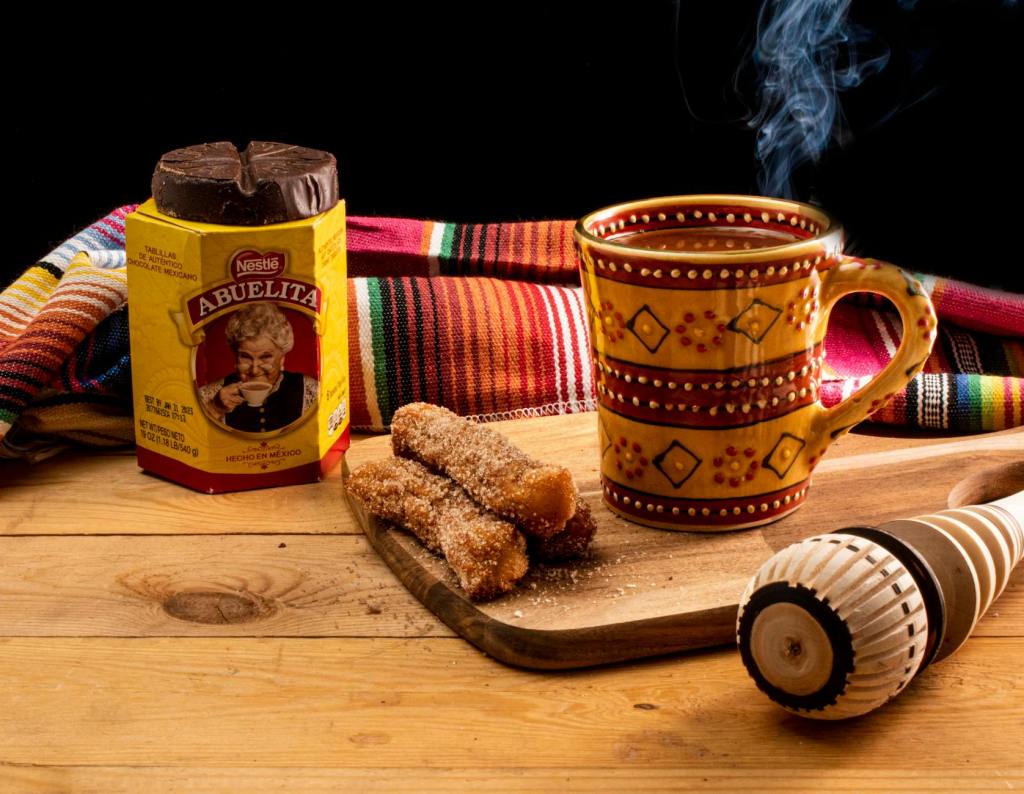
Traditionally, champurrado is prepared using a clay pot and whisked with a molinillo, a carved wooden whisk that’s rolled between your palms to create the frothy texture. Unfortunately, I don’t have a clay pot or ancient-style wooden whisk in my kitchen, so I had to rely on a saucepan and metal whisk instead. Less poetic, perhaps, but the end result is still delicious.
Champurrado is closely associated with celebrations and winter traditions, like the Feast of the Virgin of Guadalupe on December 12th, and during Las Posadas, when communities reenact Mary and Joseph’s search for shelter (if you missed last week’s blog, it can be found here!). On cool nights filled with song, candles, and togetherness, champurrado is the perfect cozy drink to keep everyone warm – in spirit and temperature.
While Champurrado has evolved over time, the base has remained the same: corn, chocolate, and spices. The recipe I use comes from a fellow blogger and food enthusiast, Jose El Cook (who also shares a video version on his YouTube Shorts). His sharing the recipe is a beautiful reminder that champurrado is a living tradition – still being made, shared, and loved today, just as it has been for centuries. The resulting texture is rich and creamy – somewhere between a drink and a pudding, and totally rich and unapologetic in its uniqueness.
So next time you’re craving something warm and comforting, skip the standard cup of hot chocolate. Make champurrado instead (maybe with a homemade biscochito? Recipe and history here)! When you take that first sip, you’re not just drinking chocolate – you’re enjoying history and culture.
- 2.5 cups water
- 2 cinnamon sticks, toasted
- 1 Tbsp cloves, toasted
- 2 tablets Ibarra or Abuelitas Mexican chocolate
- 8 oz piloncillo (substitute 1 cup dark brown sugar and 1 Tbsp molasses)
- 1 can evaporated milk
- 4 cups whole milk
- 1 cup masa harina
- 2 cups water (to mix with masa harina)
- Pinch of salt
- 1 tsp vanilla extract
- Toast Spices and Masa: In a dry skillet over medium heat, lightly toast the cinnamon sticks and cloves for 3-4 minutes until fragrant. Do the same with the masa harina in a separate dry pan until its color slightly changes (do not burn).
- Dissolve Piloncillo and Chocolate: In a large pot, add 2.5 cups of water, toasted cinnamon, cloves, Mexican chocolate tablets, and piloncillo. Stir over medium heat until everything is fully dissolved. Remove the cinnamon sticks and cloves once dissolved if desired.
- Prepare Masa Slurry: In a blender or large bowl, combine the toasted masa harina with 2 cups of water, evaporated milk, whole milk, and vanilla. Blend or whisk until completely smooth with no lumps.
- Combine and Thicken: Slowly pour the masa mixture into the pot with the chocolate mixture, whisking constantly to prevent clumping. Add a pinch of salt.
- Simmer and Serve: Bring the mixture to a simmer and continue to cook, stirring frequently, until it reaches a thick, velvety consistency (about 10-20 minutes).
Enjoy!
Mountain Girl
 Mountain Girl Goes
Leave a comment