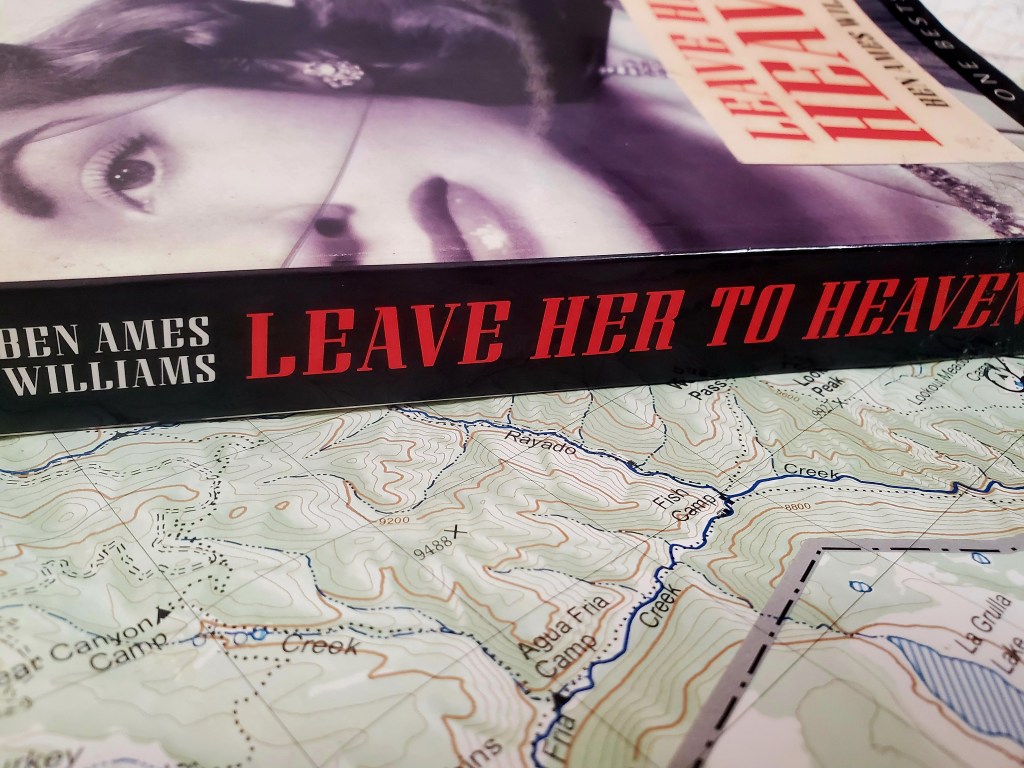
The first time I read Leave Her to Heaven, it was the summer of 2014. I was eighteen, sitting on the porch of Fish Camp at Philmont (interpreting the summer of 1928 at the very same Rayado Lodge), Sangre de Cristos towering around me, the book in my hands, and a coworker beside me whose job – interestingly enough – was to interpret the character of Ben Ames Williams.
But why would this 20th century author be sitting on the steps of a New Mexican fishing cabin? Well, he had actually been there! In July of 1928, he joined Vice President Charles Dawes – as well as the Dawes family, cartoonist John T. McCutcheon, and author Kenneth Roberts on a fishing trip hosted by Waite Phillips. The trip was interesting enough that before it even occurred, the story made the New York Times, but Dawes own words paint the picture beautifully: “The Phillips home is beautiful, and most interesting in its unusual furnishings, many of them symbolical of this unique part of the country and the art of its original inhabitants….. It is a game preserve and filled with all sorts of wildlife….. At Phillips’ camp, fifteen miles distant, where we go to-morrow by pack horse – the last seven miles there is an almost untouched trout stream – the Rayado.”
It’s easy to imagine Williams taking it all in – untouched mountain springs, pack-horse trails, the sense of being one of only a few people in the whole wild world. Allegedly, he began Leave Her to Heaven on the very train ride that brought him West for this fishing trip. Whether truth or lore, the opening of the novel makes the whole thing feel satisfyingly connected.
So how does the book begin? On a train ride to New Mexico!
Williams introduces us to our protagonist, Richard Harland, six years after a traumatic ordeal..… then yanks us back to where his story began: a chance encounter on a westbound train. On this train, Harland spots a beautiful young woman – Ellen Berent – reading one of his novels (truly, a writer’s dream!). She bats her eyelashes, he’s immediately smitten, and before long, they’re both being hosted at the same New Mexico ranch.
The whirlwind romance that follows could be described as cinematic..… and a bit disturbing. Ellen offhandedly dumps her fiancé, marries Harland in record time, and becomes one of literature’s most possessive lovers.
While the book begins to have a classic noir feel, readers may also pick up hints at Williams’ own surroundings on his 1928 trip, as Dawes once again reflects:
“At night in this high altitude the stars blaze with a light which dwellers on the plains can never enjoy. Nor, again, can they ever see a new moon and a golden planet slowly swing up from behind the black background of a great mountain which intensifies their brilliancy. Such a vision before us closes the day.”
Seems VP Dawes was a pretty poetic writer himself!
Back in the novel’s world, those starlit nights begin to form shadows. Williams structures the story almost like an extended confession – flashbacks, questioning characters’ loyalties, and the very slow dawning realization as Harland realizes how far Ellen’s possessive streak will reach. The tension here not only lies in what she might do, but also in Harland’s complicity to the situation. The reader must ask: was he blinded by beauty? Passively enabling disaster? Maybe he’s just a man swept into a situation that burns too… destructively?
The title itself – Leave Her to Heaven – is rather poetic, as it’s a quote from Shakespeare’s Hamlet, in which the prince’s ghostly father advises him not to seek revenge on Queen Gertrude but to “Leave her to heaven, and to those thorns that in her bosom lodge to prick and sting her.” Maybe Ben Ames Williams was drawing a similarity between Gertrude and Ellen, both destructive female protagonists, or maybe he was warning his readers that some people can’t be saved, only endured until fate steps in.
Leave Her to Heaven is a gripping balance of melodrama and psychological depth. Ellen isn’t your everyday, soap opera villain (as her character easily could’ve become), but rather a picture of obsession, a woman shaped by insecurity, longing, and the belief that love is something to possess and own.
When I reread the book now, I feel the same sense of fascination and dread that I felt over a decade ago on the Fish Camp porch. The knowledge that Williams himself sat on that very porch and looked at the same creeks and mountains that I saw only deepened the experience. The novel becomes not only a work of noir fiction, but a piece of Philmont-adjacent lore, born from the aspen covered hills and starlit skies above.
Maybe Williams really did begin dreaming his ideas for this novel after a day in the sun on the Rayado. Maybe the inklings came to him between pack-horse trails and the New Mexican stars. Or maybe, like Dawes wrote, those mountains just have a way of making visions blaze brighter.
Either way, Leave Her to Heaven remains a captivating tale of romance, obsession, and moral ambiguity – one that pairs nicely with a porch rocking chair, some cowboy coffee, and wind in whispering pines.
The rest is silence,
Mountain Girl
If you’re interested in more on the background of this fishing trip, I strongly recommend viewing these videos, captured by VP Dawes (the second video was primarily at Waite Phillips’ villa and Rayado Lodge), as well as reading his journal, “Notes As Vice President 1928-1929.”
 Mountain Girl Goes
Leave a comment