Facts, Feasts, and Firsts: The Oñate Origins of Thanksgiving
Everyone knows that the first Thanksgiving occurred in November of 1621 at Plymouth. Pilgrims plus Wampanoag plus three-day feast equals the official origin story of Americans giving thanks. At least, that’s what tradition tells us….. but is it actually true?
If you’ve ever fallen down an internet rabbit hole of “things I wasn’t taught in elementary school,” you might already know the answer. Our country had been explored, settled, fought over, and worshiped on for over a century before the Mayflower ever bumped into Plymouth Rock in 1620. It’s impossible to imagine that one of these explorers, missionaries, or colonists wouldn’t have paused for their own giving of thanks. Spoiler: they definitely did!
Another interesting tidbit is that Thanksgiving didn’t become a bonafide U.S. national holiday until 1863, when Abraham Lincoln declared the last Thursday in November the official annual date for the occasion (with some prodding by Sarah Josepha Hale). The date itself wasn’t even finalized until 1941 when F.D.R. made it the fourth Thursday in November….. making our modern Thanksgiving holiday younger than sliced bread!
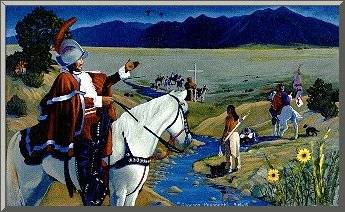
So, if the Thanksgiving story doesn’t start with the Pilgrims at Plymouth, where did it begin? The story I have for you this week begins over 20 years before that, in 1597, when Don Juan de Oñate, Spanish explorer, received land grants in what is now the American Southwest. That November, he set off from Chihuahua, Mexico, leading an expedition of 500 colonists to find the Rio Grande. Their journey was arduous, as they had to endure walking across the Chihuahua Desert, and running out of food and water four to five days before they reached the river they sought in April 1598. You can imagine the relief! After a few days of some well earned rest and recovery, Oñate ordered a day of celebration and thanksgiving on the banks of the Rio Grande near present-day San Elizario, Texas.
Oñate’s legal officer, Gaspar Pérez de Villagrá, later described the event in his epic poem Historia de la Nueva México:
“We built a great bonfire and roasted the meat and fish, and then all sat down to a repast the like of which we had never enjoyed before. . .We were happy that our trials were over; as happy as were the passengers in the Ark when they saw the dove returning with the olive branch in his beak, bringing tidings that the deluge had subsided.”
The local Manso tribe joined the Spaniards’ festivities, contributing fish and other foods to the feast. While this was certainly a celebration, there was also business to attend to. During the thanksgiving, Oñate recited La Toma, a declaration claiming the river and the surrounding land for Spain and King Phillip II. This moment is so cool because it officially marks the beginning of European colonization in the Southwest (and also the Spanish Colonial Period of New Mexico – which lasted until 1821)!
And of course, what’s Thanksgiving without entertainment? You say football and Macy’s Day Parade, Oñate and his group said “let’s put on a play!” The play, written by one of Oñate’s captains Marcos Farfan de los Godos, was titled “Comedia del recibimiento que hizo la Nueva España a la Iglesia” (“Play about the Welcoming of the Church in New Spain”) – it was a drama that told the story about Native Americans converting to Christianity under Spanish influence. This play is significant because, while we no longer have it written down, it is the first recorded theatrical performance on American soil! After this momentous historic thanksgiving, the group continued their journey up the Rio Grande and eventually settled in a place that would be known as Santa Fe.
Interestingly enough, Oñate’s celebration isn’t the only one to vie for the title of America’s First Thanksgiving. A few others include:
1541 – Spanish explorer Francisco Vasquez de Coronado observed a thanksgiving Mass by Padre Fray Juan de Padilla in Palo Duro Canyon in a search for gold.
1607 – In Maine a thanksgiving prayer was held after colonists had arrived safely.
1610 – The settlers of Jamestown, Virginia held a service for thanksgiving following the survival of a harsh winter.
So while our Thanksgiving origin story is New England born, the broader roots of the holiday span the entire map of our country – and across cultures, languages, and religions. It’s difficult to pinpoint just one “first” Thanksgiving, and our modern tradition blends countless influences combined with centuries of political, cultural, and culinary evolution.
Honestly, I really like that version: Thanksgiving isn’t about which origin story is right or true, it’s about the shared spirit of the holiday: the gratitude felt after hardship, appreciating life and community, and enduring hope for the future. So next week, when you’re passing the stuffing or debating the better cranberry sauce (canned or homemade? I say “por que no los dos?”), remember that Thanksgiving is rooted in many histories – the good, the bad, and the ugly – and no matter when the “first” Thanksgiving occurred, its message remains the same: be thankful for what you’ve endured, cherish what you have, and look forward to what’s ahead….. and pass the gravy.
 Mountain Girl Goes
Leave a comment