Chances are, if you picture the American West of the 1800s, prim and proper women in black and white uniforms aren’t alongside the gunslingers and tumbleweeds of your mental image. And yet, for nearly a century, more than 100,000 women headed west via the expanding railroads to work as Harvey Girls (never to be called waitresses!). These women helped temper the Wild West and also paved the way for women in the workplace.
Before the suffragettes marched for voting rights (the organization founded in 1903) or PanAm stewardesses glamorized air travel, the idea for the Harvey Girls was forming. Opportunities for women in the 1880s were relatively limited – running a household, domestic services, or teaching were pretty much it. Thanks to Fred Harvey, American women had a new option open up, and it included independence and adventure!
The mastermind behind the Harvey Girls, Fred Harvey, was an English immigrant who arrived in New York in 1853 at the age of 17. After working in kitchens and restaurants for a while, Fred eventually became co-owner of his own restaurant, but life had other plans for him: after his business partner died in the Civil War and Fred’s wife and children tragically passed away, he was forced to pick up the pieces of himself and start from scratch.
Becoming a freight agent for the railroads, Fred had a good look into a major problem with the current mode of travel: railways were terrible at customer service (sheesh, I understand that….. try working a “real world” job after growing up in a tourist town…raised by a Boy Scout!). Passengers on the trains were lucky if they could snag a plate of something resembling food during a stop. Fred, with his restaurateur’s soul, saw the future of travel: fresh food and clean tables..… imagine that!
He took his idea to the Missouri Pacific line first, but they turned him down. Not to be discouraged, he went to the smaller Atchison, Topeka, & Santa Fe Railway (A.T.& S.F.), and they said “Yes!” And in 1878 in Florence, Kansas, the first Harvey House was born. Not long after, the Santa Fe (as it’s often called) was outpacing its competitors in both mileage and reputation. The company became the first railway to reach New Mexico, and Fred was not far behind, scattering his Harvey Houses across the landscape of the Southwest.
As you might already be aware, places like Dodge City or Colorado mining towns weren’t glowing examples of polite society in the 1880s. Cowboys, miners, and railroad men often made for rowdy crowds. When Harvey Houses were first opened, they often employed African American men, and unfortunately, following the Civil War, tensions were still high. In Raton, New Mexico in 1883, a bar fight broke out because some of these rowdy customers refused to be respectful of their waitstaff. During the subsequent visit to this particular Harvey House, a friend advised Fred to hire women instead… What better than that to cool down the raging testosterone riddling the Wild West (honestly, that’s not the conclusion I would’ve come to). Fred saw it as a wonderful opportunity for refinement and better customer service for his patrons, and agreed to give it a shot, starting in Raton.
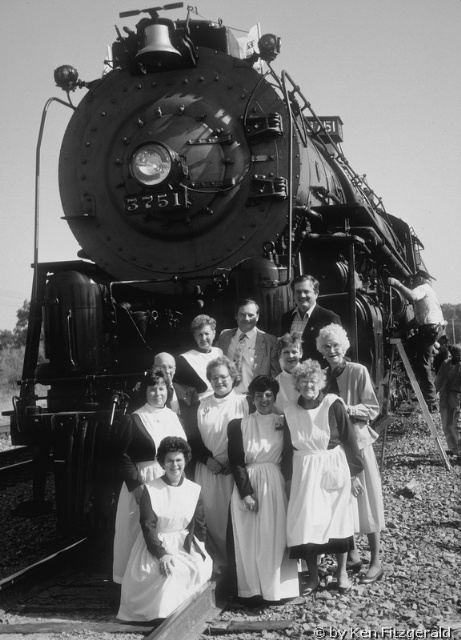
It was such a success, that soon all Harvey Houses employed these young, intelligent, pretty, and single women of good character (if only that’s all it took on my resume) as Harvey Girls (not waitresses, thank you very much). For thousands of women, becoming a Harvey Girl was revolutionary. Along with the salary of around $20 a week, they received free room and board, rules and protection, and a chance at adventure. One Harvey Girl said the most important thing the opportunity provided was that “it gave women a chance to move out of the lives they were locked into and to be able to be a bit adventuresome.” In an era where many girls were still expected to stay near home, Harvey Girls boarded trains and traveled into the cactus spotted horizon. These women lived in female-only dormitories, overseen by an often formidable dorm mother, whose approval was required even for a date. To further protect reputation, Fred Harvey made sure the uniforms were modest and put together – a black dress, starched white apron, polished shoes, hair neatly pulled back, and no accessories – in order to combat the stigma at the time that waitresses were often “loose” (another reason they only went by “Harvey Girls”).
As they began to show up in Harvey Houses around the Southwest, demographics of these frontier towns began to change, and many a cowboy, rancher, or miner cleaned-up for a chance at one of these women deemed a “civilizing influence.” So often these girls would find love on the job that Harvey Houses were jokingly referred to as “the largest marriage bureau in the West.” Once married, women could no longer work as a Harvey Girl, but many stayed in the communities in which they found themselves, further anchoring what once might’ve been considered transient towns.
The Harvey legacy also transformed American tourism. Ford Harvey, Fred’s son, championed the idea of developing the Grand Canyon as a tourist destination. He then built the Harvey House known as Bright Angel Lodge on the canyon’s rim, introducing travelers to one of the most stunning natural wonders of the world.
By the 1940s, Harvey Girls were firmly a part of American nostalgia, and Hollywood came calling, producing the film The Harvey Girls in 1946 starring Judy Garland and Angela Lansbury – a tribute to the women who brought order, charm, and good food to the West.
The Harvey Girls were more than servers..… they were pioneers of the West – venturing out when doing so was unconventional and risky. They forged careers, helped shape communities, and helped redefine what women could or should be. This isn’t a story about the meals the served or the towns they tamed, but about the century-long impact of the determination of tens of thousands of adventurous women.
All Aboard!
Mountain Girl
 Mountain Girl Goes
Leave a comment