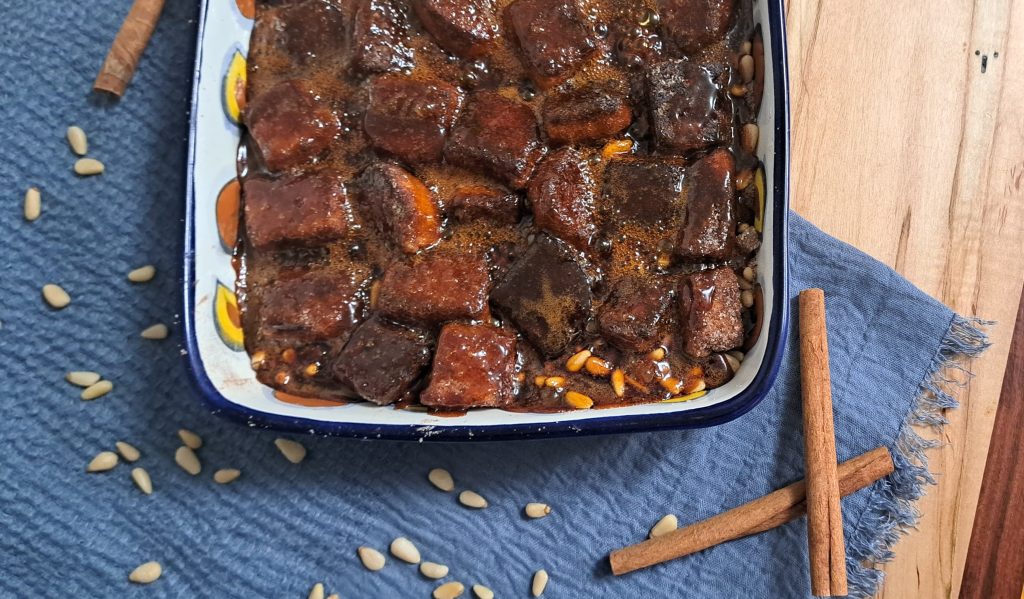
I’ve been itching to share this recipe, and with piñon season in full swing, the time is just right! Picture this: toasted piñon nuts, a sprinkle of cinnamon, and golden fried bread coming together in a cozy, autumnal hug. This isn’t just any bread pudding—it’s Capirotada (or Torrejas), a dessert that carries the soul of Territorial Period New Mexico, from the kitchen of Josefa Jaramillo Carson, the wife of legendary frontiersman Kit Carson.
We’ve all heard tales of Kit Carson’s daring as a scout and soldier, but Josefa? She’s the unsung hero of this story—a Taos girl who became his steadfast wife, the mother of his children, and the keeper of their hearth through thick and thin. Her life, and this bread pudding, weave a tale of warmth, tradition, and love that echoes across centuries.
Maria Josefa Jaramillo was born near Taos in 1828, during the Mexican Territorial Period, two decades before New Mexico joined the U.S. under the Treaty of Guadalupe Hidalgo. Her dad was a successful merchant, and her mom a landowner with acres along the Rio Grande. In 1842, a 33-year-old Kit Carson rolled into Taos, fresh from guiding John Fremont’s survey expedition. There, he met 14-year-old Josefa and was smitten by her “grace and elegance.” She, in turn, saw his “fearlessness and sense of decency,” as the Rio Rancho Observer noted in 1907. Kit nicknamed her “Chipeta,” his “little songbird” (how sweet is that?).
A year later, after Kit converted to Catholicism to win over her dad, they tied the knot at Our Lady of Guadalupe Church in Taos. The ceremony, led by the notorious Padre Antonio Martinez, had Josefa’s sister, Maria Ignacia, and her husband, Charles Bent, as witnesses. (Fun fact: Bent became New Mexico’s first Territorial Governor in 1846 but was killed in the 1847 Taos Pueblo Revolt. Stay tuned for a blog post about him!)
Just three months after their wedding, Kit was off on another Fremont expedition, leaving his 15-year-old bride to hold down the fort on the Cimarron River. Their early years were a whirlwind of separations, with Kit’s travels and the Mexican-American War keeping him away. After the war, they settled in Rayado, a tiny settlement 11 miles from Cimarron, where Kit helped his buddy Lucien Maxwell manage his sprawling land (Maxwell Land Grant anyone? Revisit my blog “Oilman’s Opus” from June to learn a little more!). Josefa soon realized her husband wasn’t cut out for ranching or farming—his heart was in protecting their community from frequent raids.
Josefa’s courage matched Kit’s, her devotion shining through every hardship. She raised six children, starting with their son, Charles Bent Carson, born in Rayado in 1849 (named after her late brother-in-law, though sadly, the boy passed at age two). Later, they adopted three Native American orphans during Kit’s time as an Indian Agent.
Despite his rugged reputation, Kit was a softie at home. Captain Rafael Chacon of the New Mexico Volunteers recalled:
“He’d lie on an Indian blanket outside, pockets stuffed with candy and sugar lumps. His kids would pile on, raiding his pockets for sweets, and he’d just beam. He was so kind to his wife, Doña Josefa Jaramillo.”
Tragically, Josefa’s story ended in 1868, just two weeks after giving birth to their seventh child. Childbirth complications—a harsh reality of the era—took her too soon. Kit followed her to eternity a month later.
So, why share all this history? Because food tells stories! This capirotada isn’t just dessert—it’s a connection to Josefa’s kitchen in Taos or Rayado, her kids underfoot, the aroma of cinnamon and piñons filling the air. As you make this dish, imagine her there, guiding you with a smile. Nearly two centuries later, we’re linked by these warm, fall flavors.
Now, the moment you’ve been waiting for—the recipe! Straight from Josefa’s granddaughter in the Pioneer Potluck cookbook, here’s Josefa Jaramillo Carson’s Capirotada (or Torrejas):
Ingredients:
- 2 ½ cups toasted bread cubes
- 1 egg
- Lard or shortening (for frying)
- ¼ cup sugar
- 1 tsp cinnamon
- ¾ cup piñon nuts
- ½ cup finely chopped citron
Syrup:
- 2 cups sugar
- ⅛ tsp cream of tartar
- 1 cup water
- ½ tsp cinnamon
Instructions:
- Separate the egg, beat the white until stiff, then mix in the yolk and beat again.
- Dip toasted bread cubes in the egg mixture and fry in hot lard or shortening until golden. Drain on paper towels and arrange on a warm serving dish.
- Mix sugar and cinnamon, then sprinkle over the bread cubes along with citron and piñon nuts.
- For the syrup, combine sugar, cream of tartar, water, and cinnamon in a saucepan. Heat gently until boiling, then cook until the syrup forms threads when drizzled from a spoon (this will take longer than you expect!).
- Pour the hot syrup over the bread cubes and serve immediately.
Dig in and savor the history!
Mountain Girl
P.S. Don’t miss next week’s post—my husband’s taking over for a spooktacular Halloween-themed blog!
 Mountain Girl Goes
Leave a comment