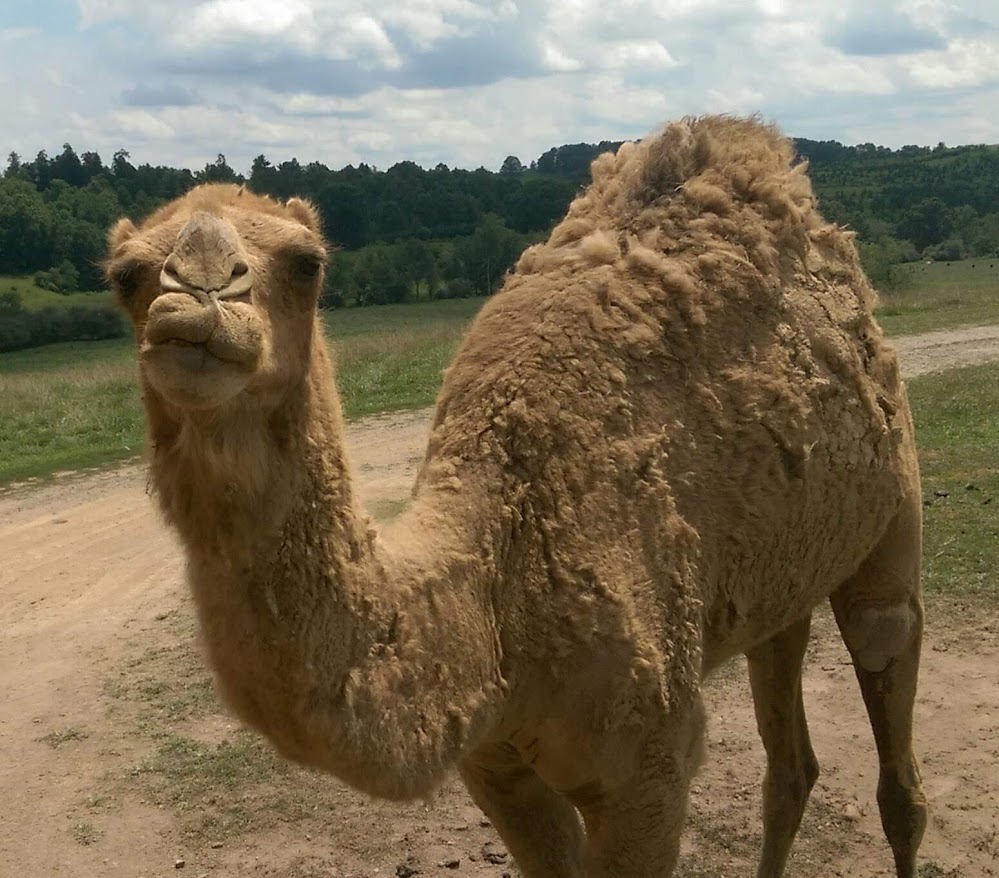
While some Philmont folk (…pholk?) have heard of the roaming camel named Omar, do you know his origin story? Waite Phillips’ son Elliott (perhaps better known as Chope), kept a variety of unusual pets around, including a squirrel and raccoon. It seems keeping odd animals was a family trait, because one summer while visiting his uncle Frank Phillips at Woolaroc, Oklahoma (designed by Edward Delk – the same architect who built the Villa! See my post from June 27th for more information) he became enraptured by his uncle’s herd of camels. After mentioning how much he liked the idea of having one, Frank gifted Chope a yearling, and that is how Omar came to live in the pasture underneath the Tooth of Time!
Omar was far from the first camel to be in the southwest though! In 1856, Jefferson Davis – then U.S. Secretary of War and the future (and only) president of the Confederacy – thought, “You know what we need for Southwest exploration? Camels, obviously.” And so, in the region where water was scarce, travels West contained unknown variables, and camels were thought to be able to carry much more than mules, the United States Camel Corp was born. Congress allowed $30,000 (the equivalent of about one million dollars in today’s money) for the “purchase and importation of camels and dromedaries to be employed for military purposes.” By 1857, 75 camels were imported to Camp Verde, Texas, where they were stationed as pack animals and for various expeditions within the state and beyond – one unit going all the way to California! Although camels proved themselves to be well suited for the region and the job, they were generally rather unpleasant creatures who developed a pastime of scaring horses and wandering off at night… I suppose there’s a reason they’re called dromedaries (ba dum tss). Their overall unpopularity and the Civil War ultimately saw the end of the experiment. Prices to import were too high, and when Texas seceded from the United States, Confederate forces seized both Camp Verde and its camels. As for what happened to the creatures, many were auctioned off, some given to zoos, many others still were destined to be wayward desert wanderers, like the fabled Red Ghost of Arizona.
The tale of Red Ghost saw its beginning in 1883 – nearly 20 years after the Camel Corp was disbanded – when a woman was found trampled to death, and surrounding her body were unusual footprints and clumps of reddish fur. Not long after, the menace ran through some miners’ tents, and again only footprints and fur were left behind. Eventually reports began to come in of sightings of the creature, some saying he was as big as 30 feet tall, and some saying the camel had a rider who appeared to be dead. The Red Ghost continued his somewhat bumbling reign of terror until 1893 when a rancher spotted him on his property and killed the poor beast, who at this point only had an empty saddle on his back.
So, while Omar lived a peaceful life among the silver on the sage and starlit skies above, he was part of a strange tradition of camels in the American Southwest. From Chope Phillips’ quirky pet to Jefferson Davis’ company of camels, and finally to the La Llorona of dromedaries, these creatures have left their own dusty footprints in the clay of the region.
Stay hydrated,
Mountain Girl
 Mountain Girl Goes
Leave a comment